


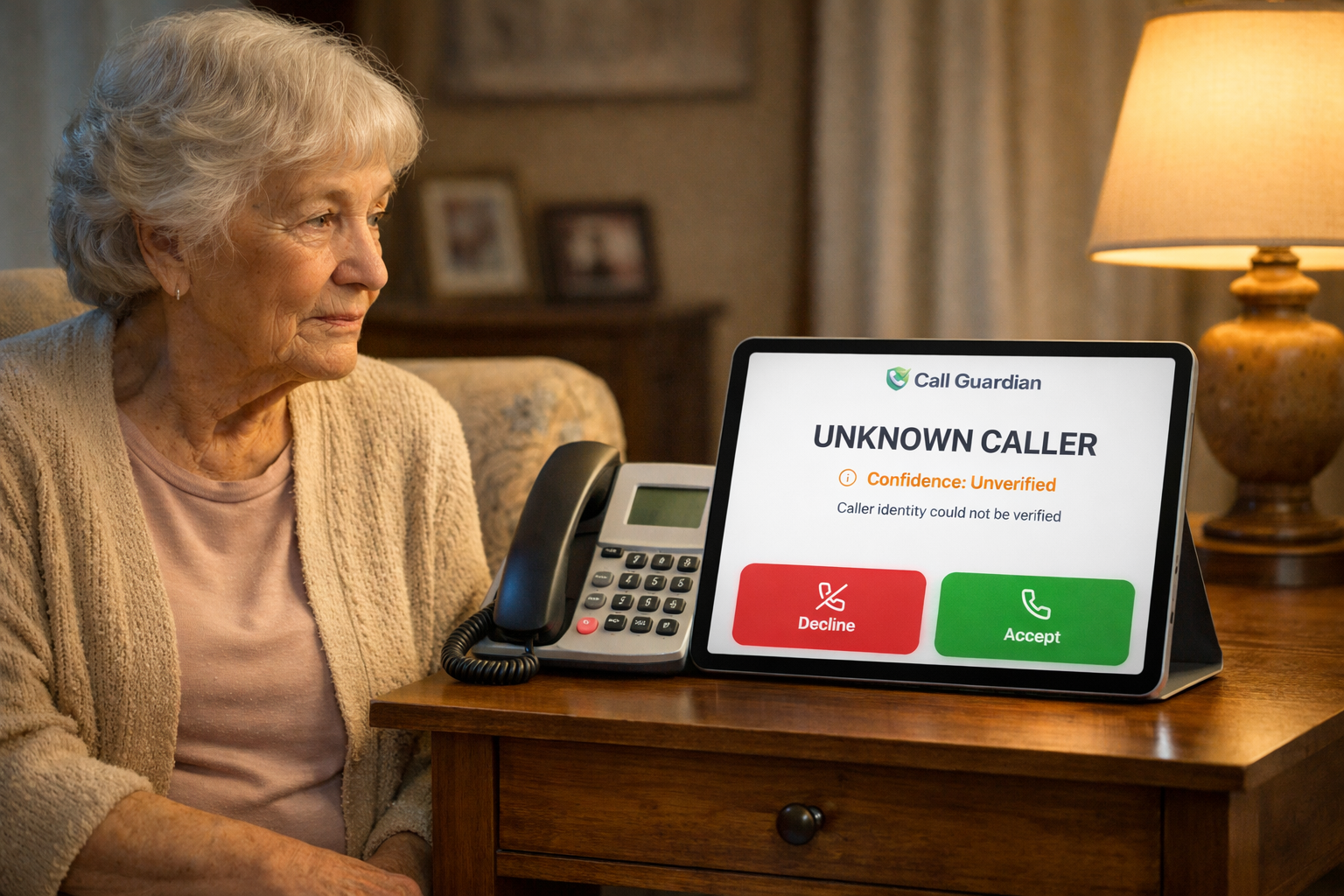
Call Guardian is a speculative phone interface concept designed to help older adults navigate unknown calls with greater clarity, safety, and dignity. The project explores how the experience of receiving an unfamiliar call might be redesigned to reduce pressure, support trust-based decision making, and offer safer paths forward without removing user independence.
Project Overview
This project asks how phone calls might become safer and more understandable for older adults in moments of uncertainty. Rather than treating unknown calls as a simple technical problem, this project frames them as emotional and social experiences shaped by trust, urgency, and incomplete information.
The concept focuses on the moment an unknown call appears and imagines a more supportive interface that helps users interpret the situation before responding. The prototype introduces contextual trust cues, optional support from trusted contacts, and safer alternatives to answering immediately.
At its core, this project is about designing for safety without shame. It aims to support confidence, autonomy, and dignity in everyday interactions that can otherwise feel confusing or high-pressure.
Documentation Video
This documentation video provides a self-contained overview of the project, including the central design question, the broader vision, the polished prototype, and the process used to develop the concept.

Big Design Question
How might phone calls become safer, more understandable, and more dignifying for older adults navigating unknown callers, uncertainty, and potential fraud?
This question emerged from an interest in how people interpret unfamiliar calls in everyday life. An unknown call is often treated as a simple prompt to answer or decline, but in reality it can create immediate emotional pressure. Users are asked to make a judgment with very little information, often while being interrupted, surprised, or uncertain.
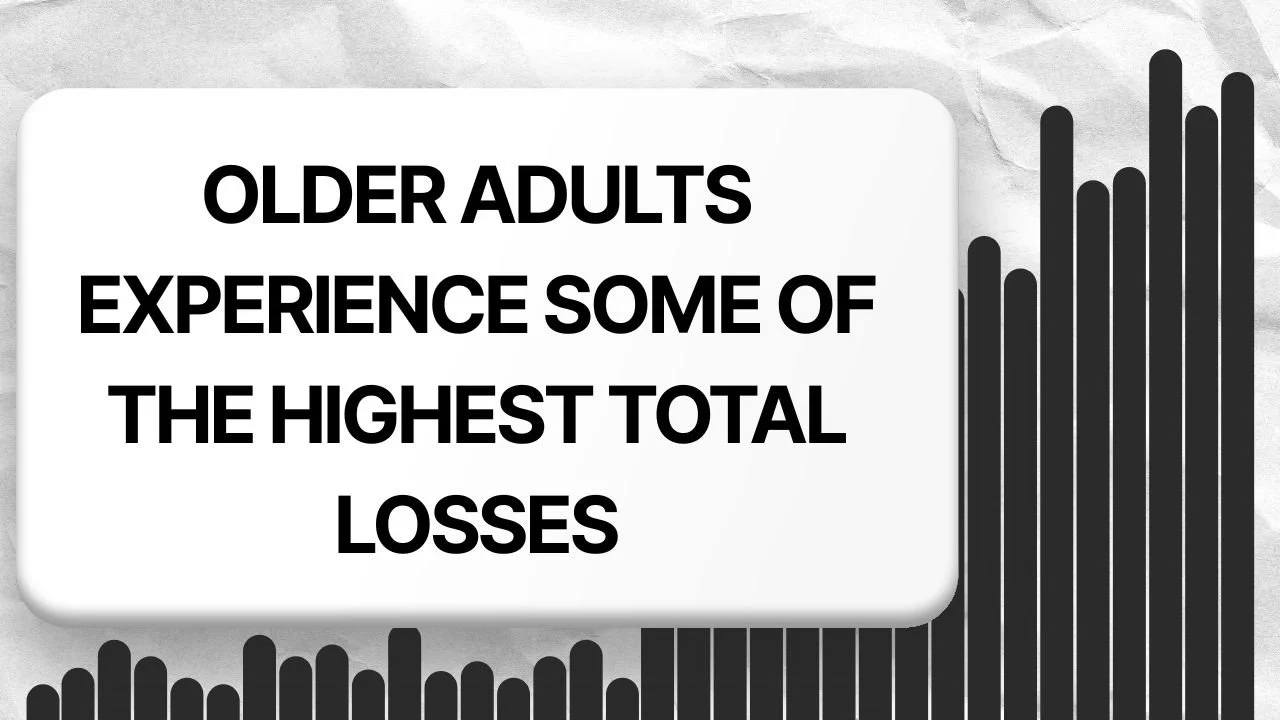
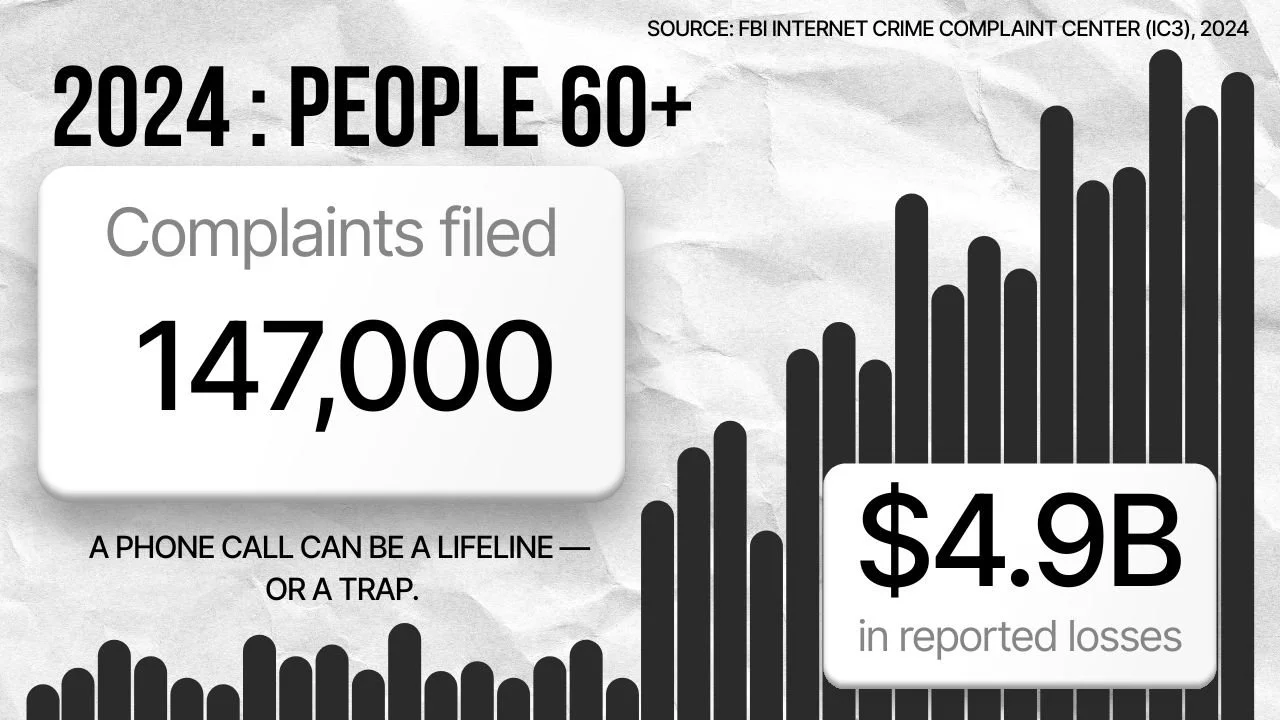
For older adults in particular, this moment can carry additional weight. Phone scams frequently rely on urgency, impersonation, and emotional manipulation. At the same time, many existing responses to fraud place the burden entirely on the individual, suggesting they should simply be more cautious or more informed. This framing overlooks the role of interface design in shaping how trust, risk, and action are experienced in the moment a call arrives.
This project approaches the problem not only as one of fraud prevention, but as a broader design question about clarity, agency, and dignity.
Motivation and Context
This project is motivated by the growing challenge of scam calls, fraudulent outreach, and the emotional uncertainty created by unknown callers. While public conversations around fraud often emphasize awareness and personal responsibility, they rarely address how communication systems themselves might better support people in real time.
The societal theme behind this project is the relationship between aging, trust, and digital independence. Many people, especially older adults, are expected to manage increasingly complex communication environments without supportive tools that reflect the emotional and cognitive realities of those interactions. Unknown calls are not only informational events. They are social encounters that can create confusion before a caller even speaks.
I was drawn to this topic because it sits at the intersection of communication design, care, and everyday vulnerability. I wanted to explore whether a phone interface could do more than simply display a number and demand a decision. Instead, I wanted to imagine an interface that could slow the moment down, make it more legible, and help people respond in ways that feel safer and more self-directed.
Related Projects & Influences
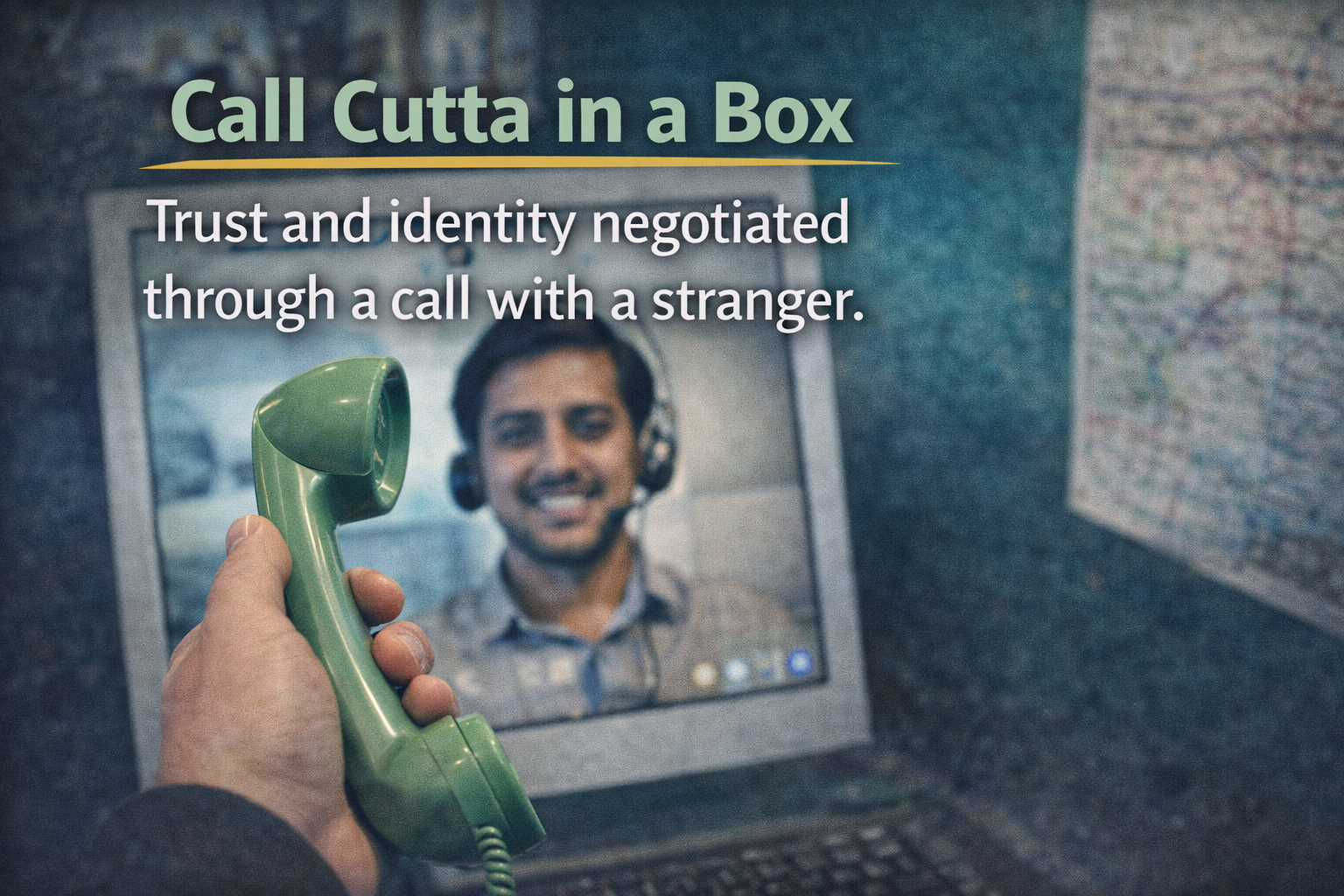
This reference was important in showing how trust and identity can be negotiated through a call with a stranger. It opened up the possibility that phone-based interaction can be carefully designed as an experience, rather than treated only as a utility.

This project influenced my thinking about the phone call as intimate, uncanny, and layered with performance. It helped me understand that phone interactions are never purely neutral or technical. They are shaped by emotion, uncertainty, and interpretation.

This reference broadened the project beyond fear and fraud by showing that the phone can also be a medium for care, art, and meaningful connection. It reminded me that redesigning the phone should not only be about defense, but also about preserving humanity and possibility in communication.
Big Vision
Call Guardian imagines a future in which phones do more than ring and force immediate judgment. Instead, the phone becomes a calmer and more supportive interface that helps people interpret incoming calls, understand context, and choose safe next steps without panic or shame.
This vision is larger than a single prototype screen. It proposes a broader communication ecosystem built around trust cues, contextual guidance, optional verification, and supportive pathways that respect user independence. Rather than assuming people need to be protected from their own decisions, the concept asks how systems might help users feel more informed and capable in the moment a call arrives.
The primary audience for this vision is older adults who regularly encounter unknown calls and who may benefit from better support in moments of uncertainty. At the same time, the concept also considers family members, caregivers, and trusted contacts who may be part of a wider support network. The goal is not to transfer control away from the user, but to make support available in a way that remains optional and respectful.
If realized more fully, a system like this could reduce anxiety, improve confidence, and help users navigate uncertain communication on their own terms. It could also shift the design conversation away from alarm and blame, and toward dignity-centered tools for everyday safety.
Onboarding Experience
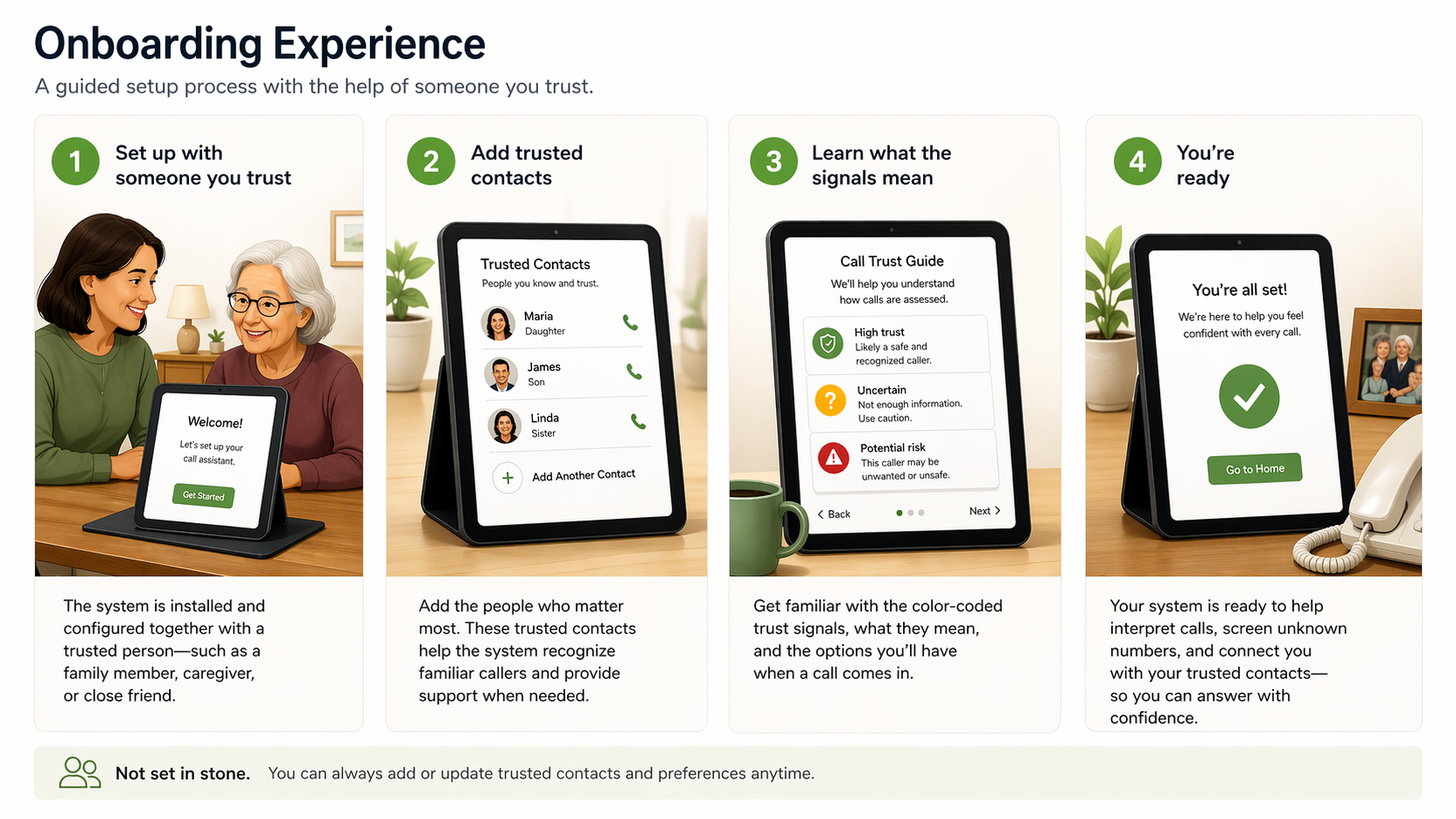
The onboarding experience is designed as a guided, supportive process that helps users confidently set up the system with assistance from a trusted person. Rather than treating setup as purely technical, it emphasizes clarity, reassurance, and shared decision-making by introducing features like trusted contacts, customizable call preferences, and a simple walkthrough of the interface. Once active, the system enhances incoming calls with contextual information, AI-generated insights, and calm visual cues that reduce urgency and pressure. By offering alternatives to immediately answering—such as consulting a trusted contact or reviewing additional context—it reframes the moment as a thoughtful decision rather than a reaction. Overall, the system is built to support user autonomy, making unknown calls more understandable while preserving dignity and control.
Working prototype link: click on image above
Polished Prototype
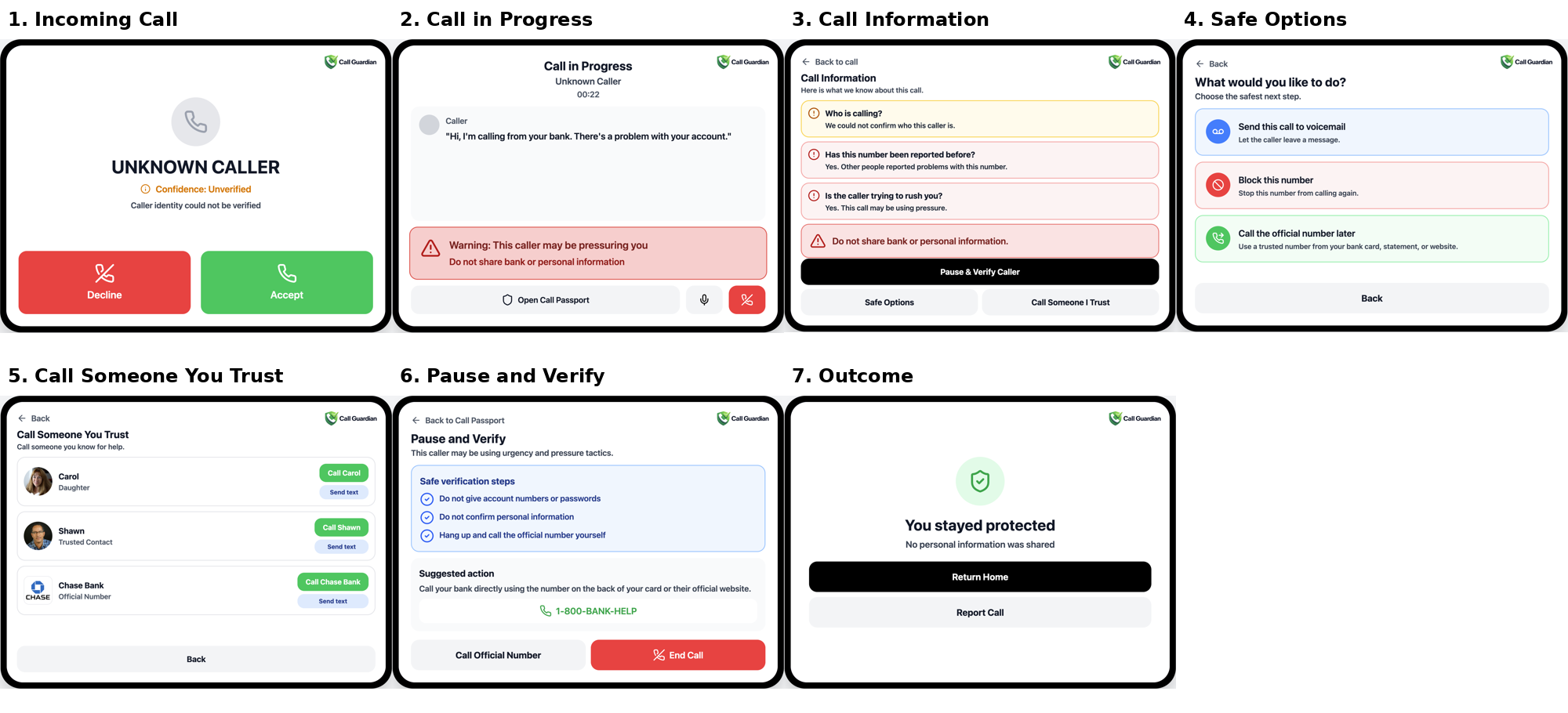
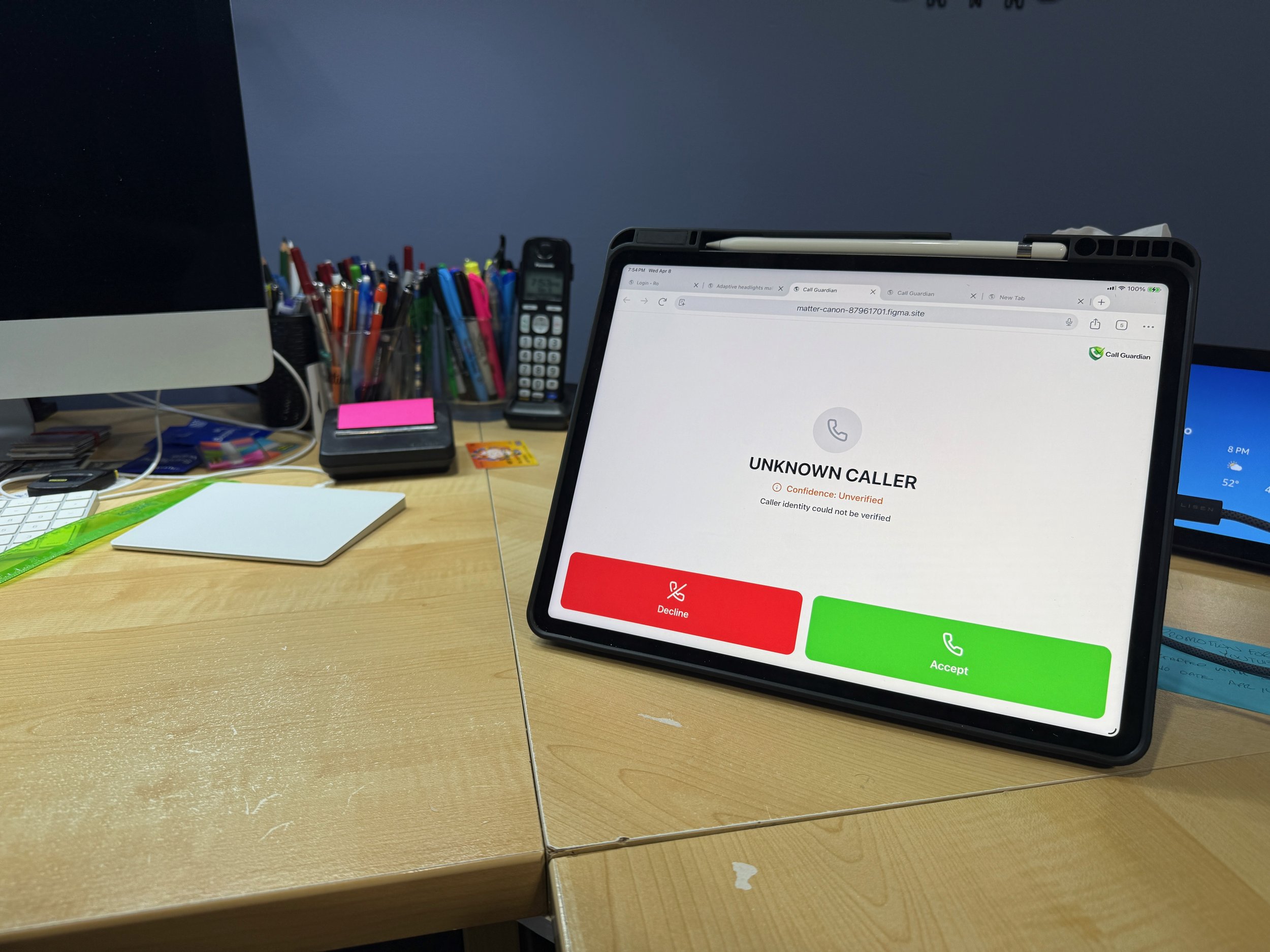
The prototype focuses on the moment an unknown call appears and explores how interface design might make that moment easier to interpret, slower to escalate, and safer to navigate. It does not attempt to solve fraud through perfect detection alone. Instead, it imagines a more supportive experience that helps users make informed choices before, during, and after the call. The image to your left is a working prototype of Call Guardian.
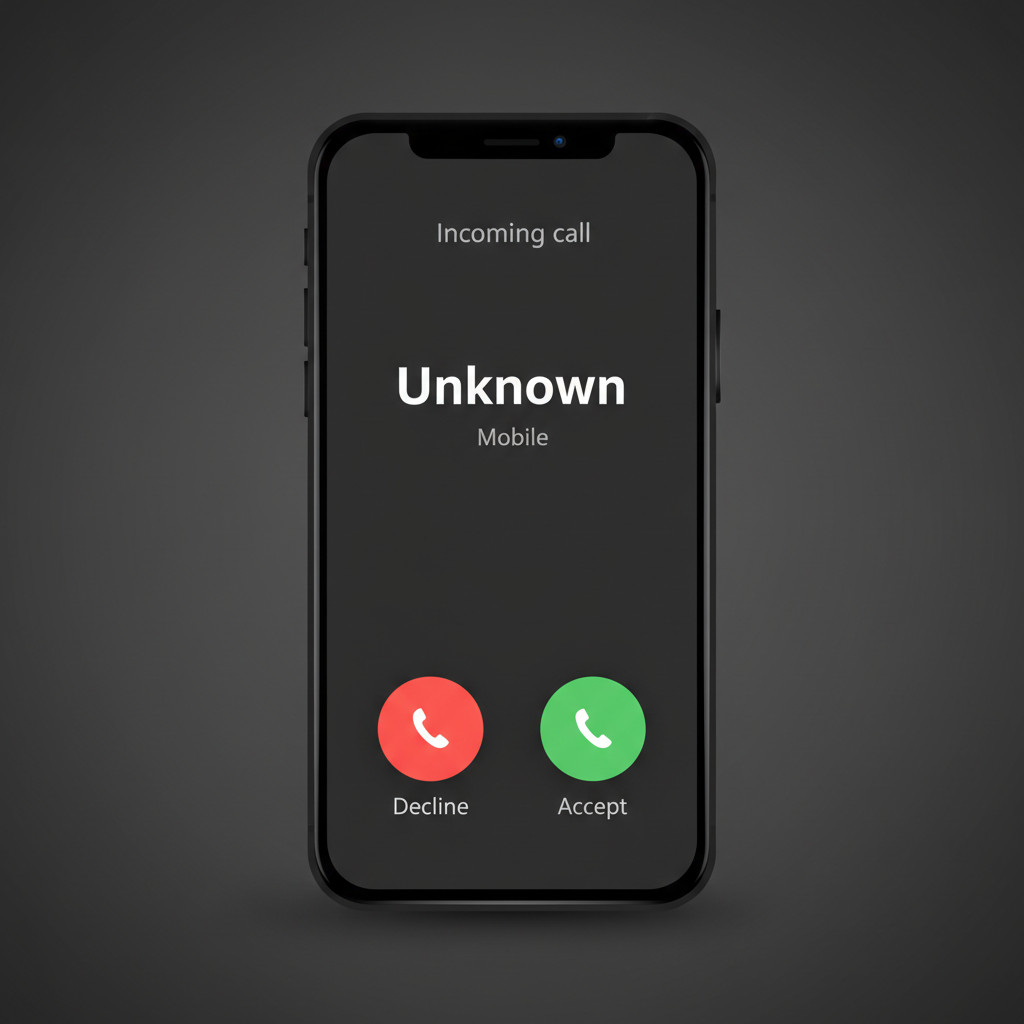
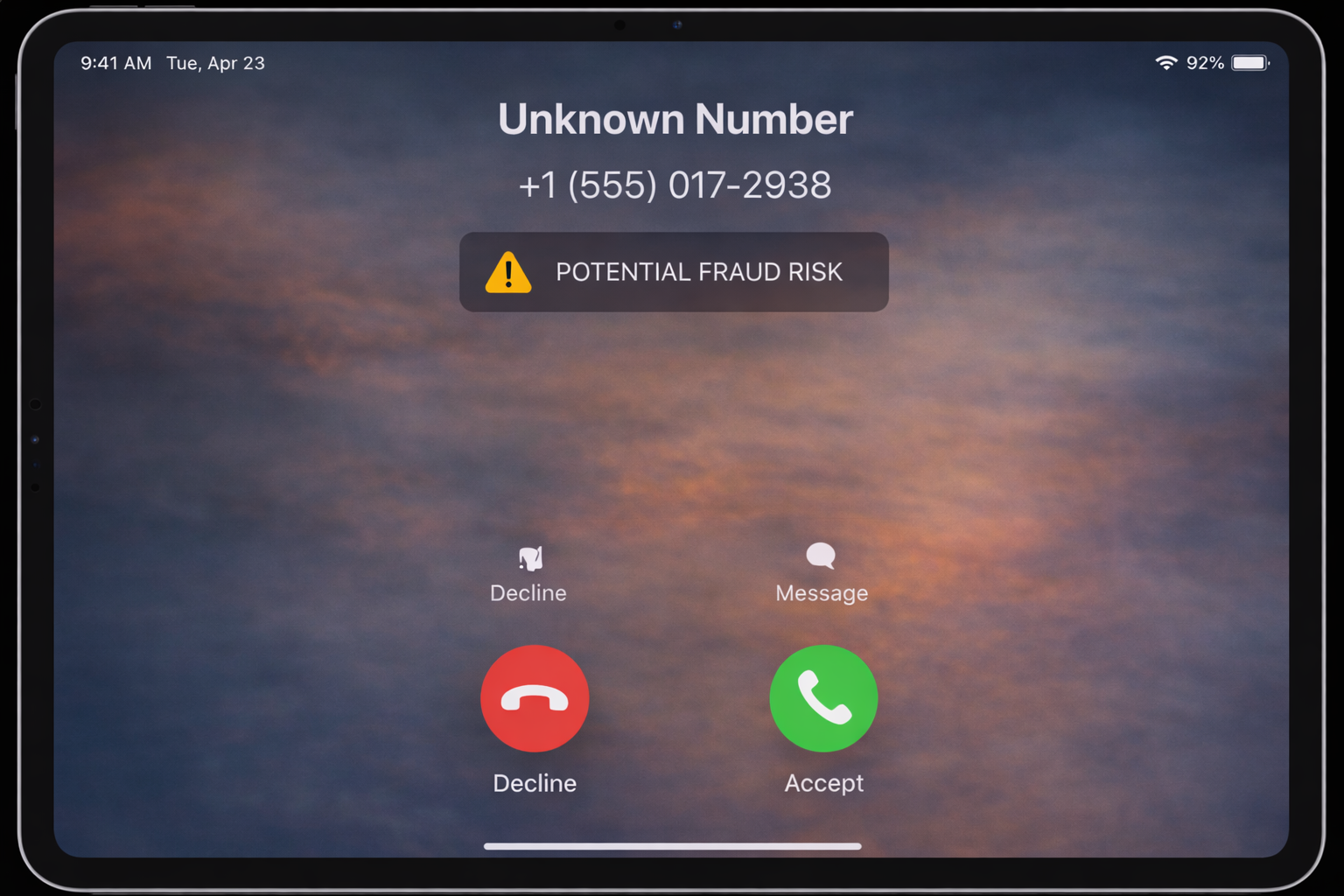
Incoming Call
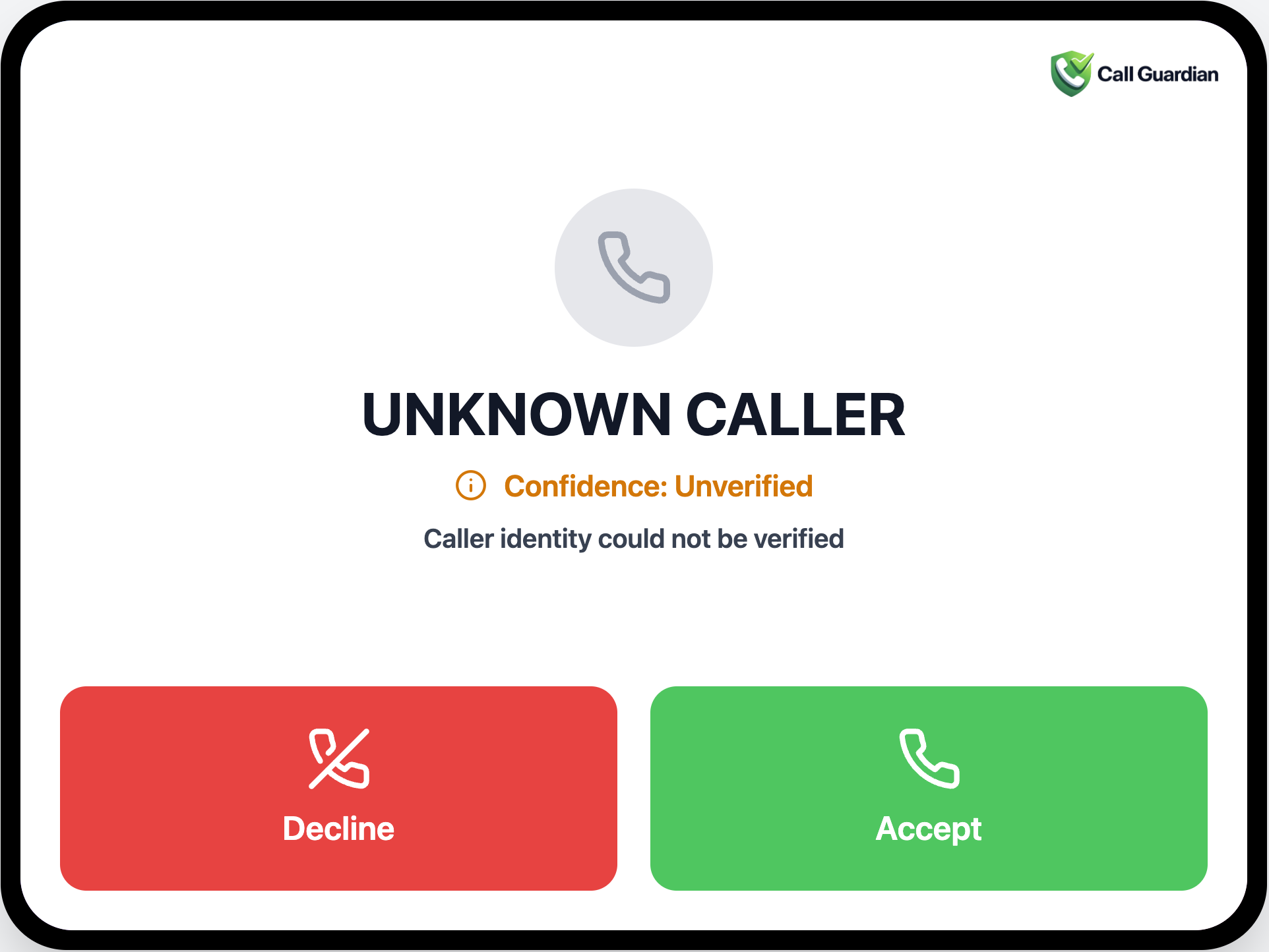
The first screen presents the familiar uncertainty of an unknown incoming call. This moment is intentionally simple, reflecting how quickly users are usually expected to decide whether to answer. By starting with a recognizable phone interaction, the prototype grounds the project in an everyday experience.
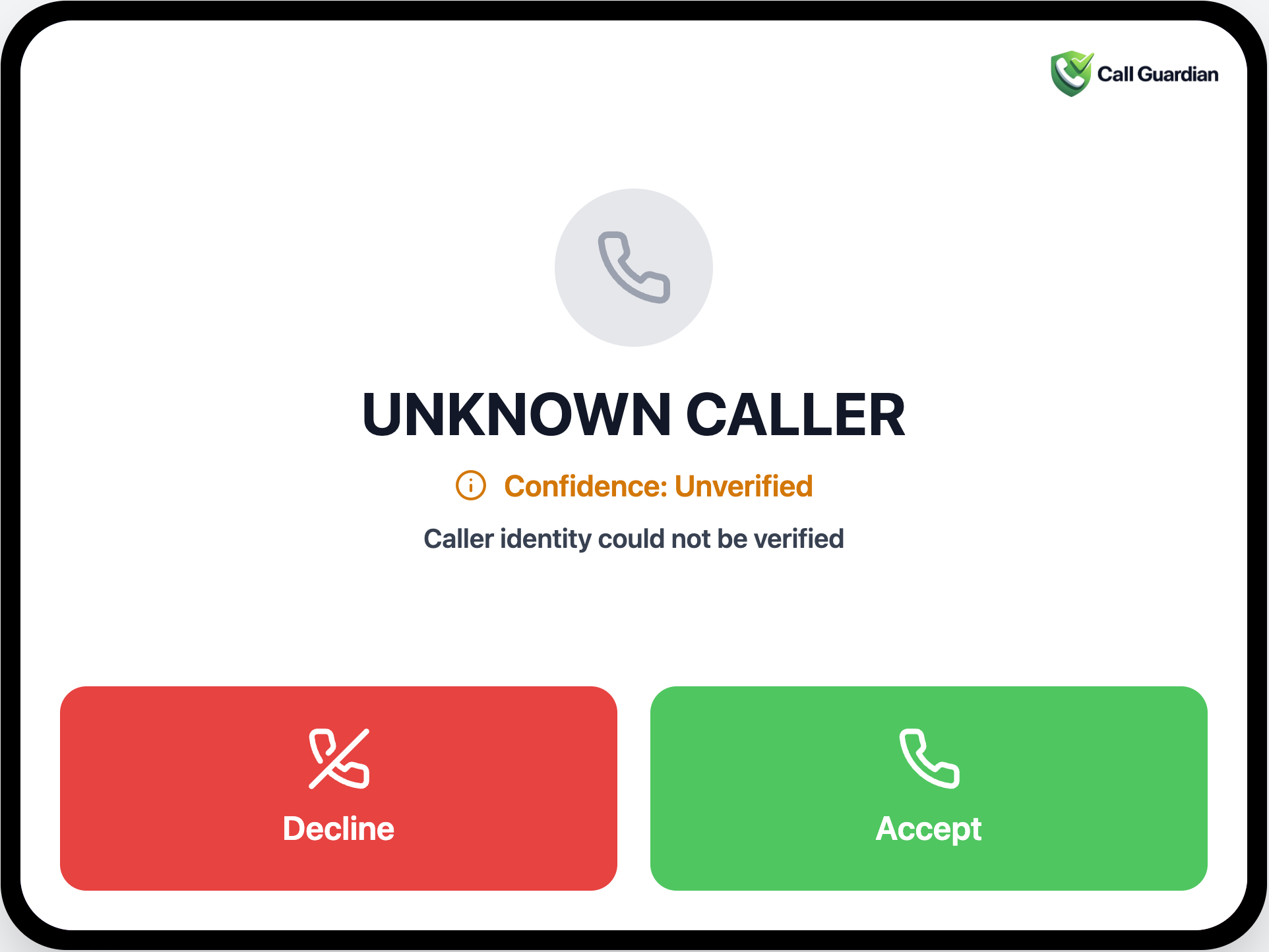
Incoming call screen showing the initial uncertainty of an unfamiliar caller.
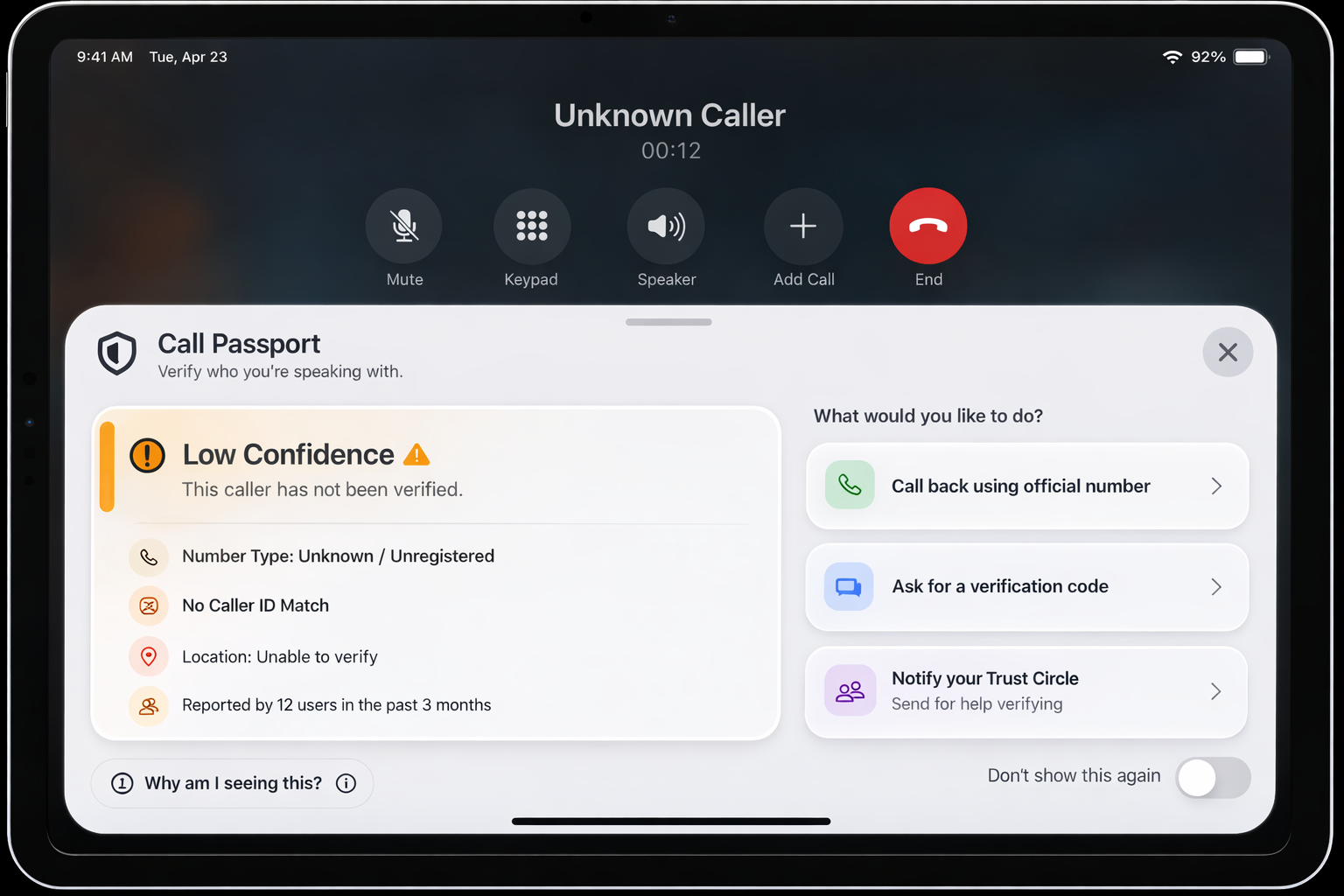
Call Passport Overlay
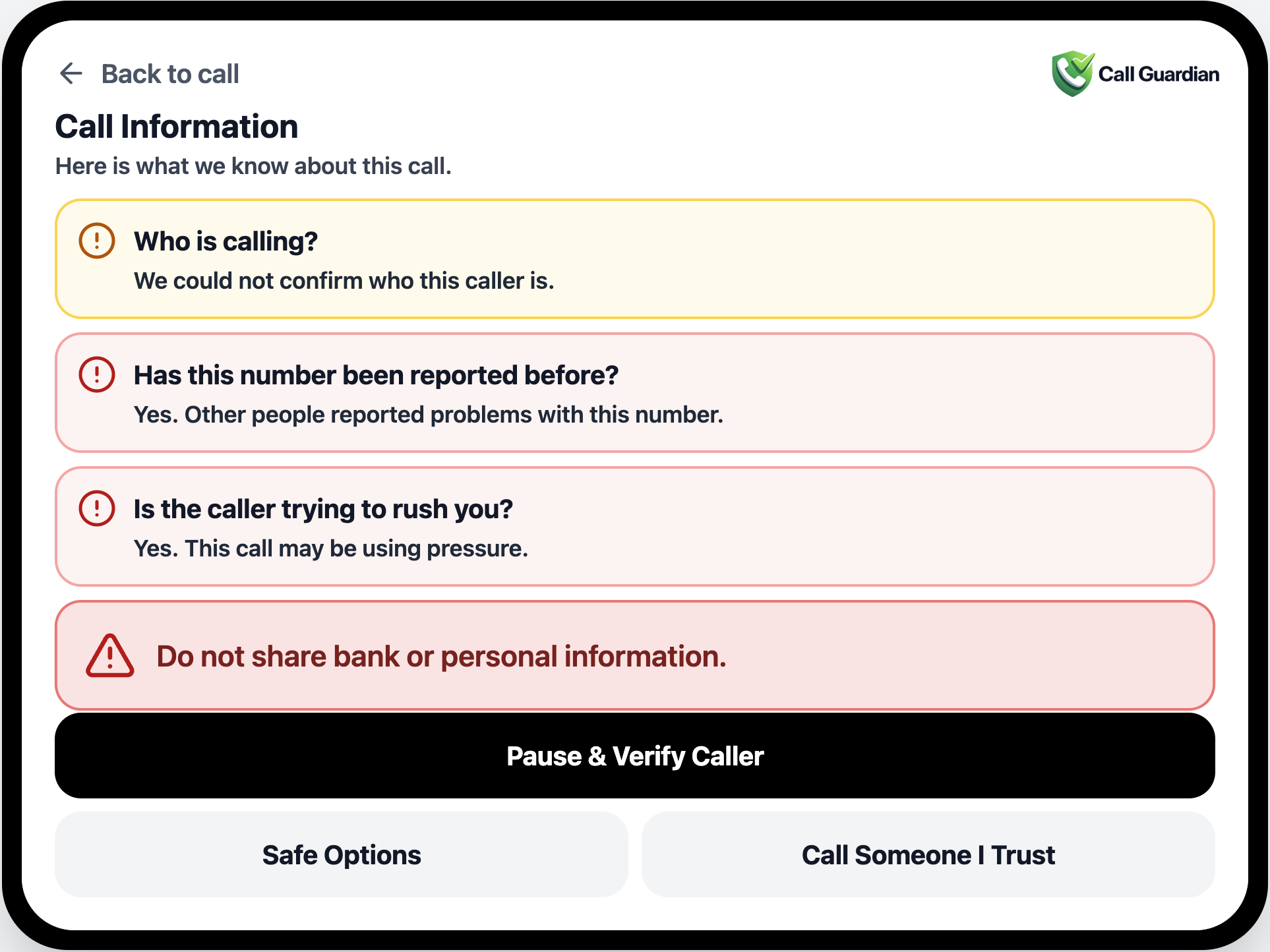
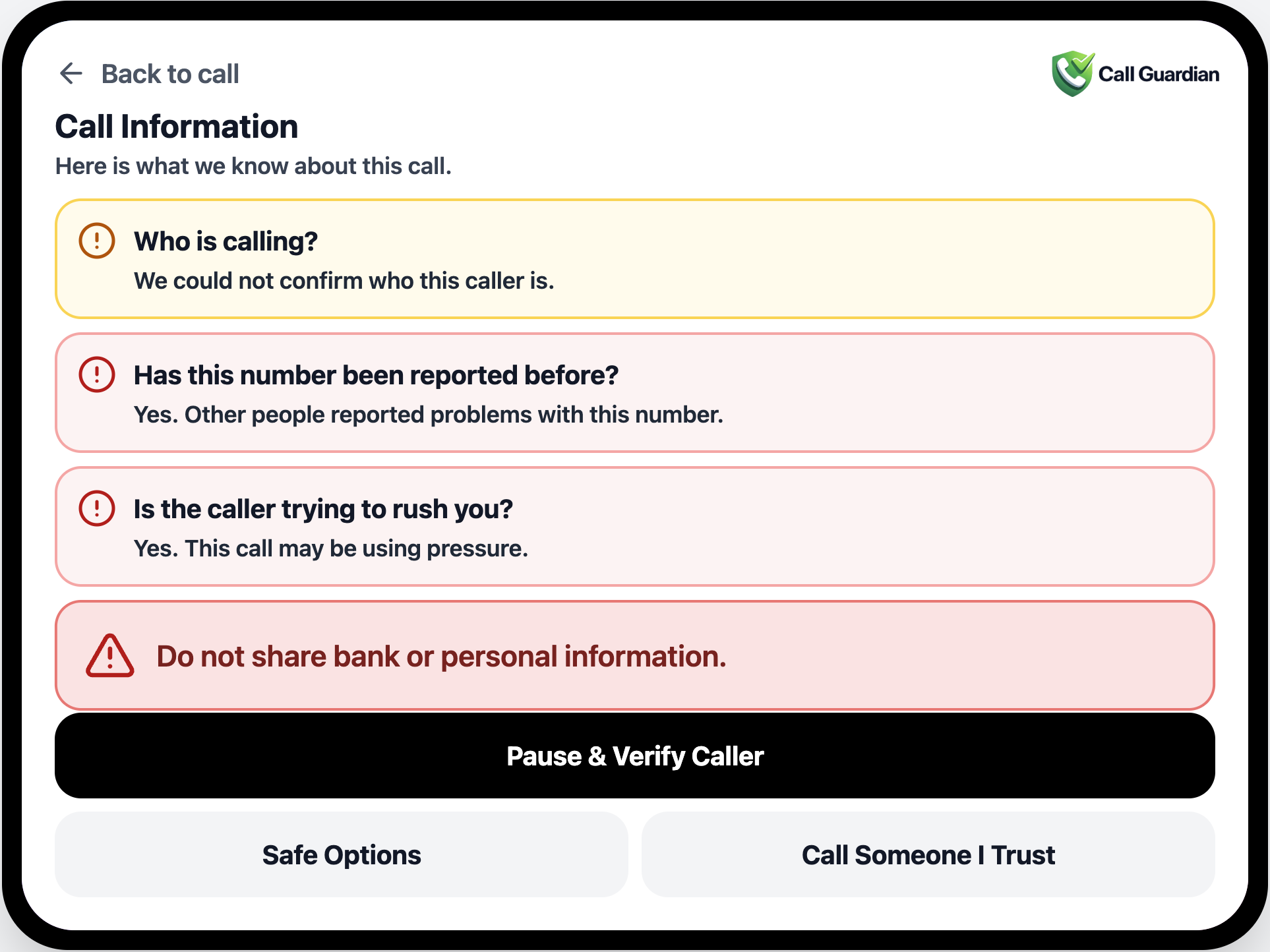
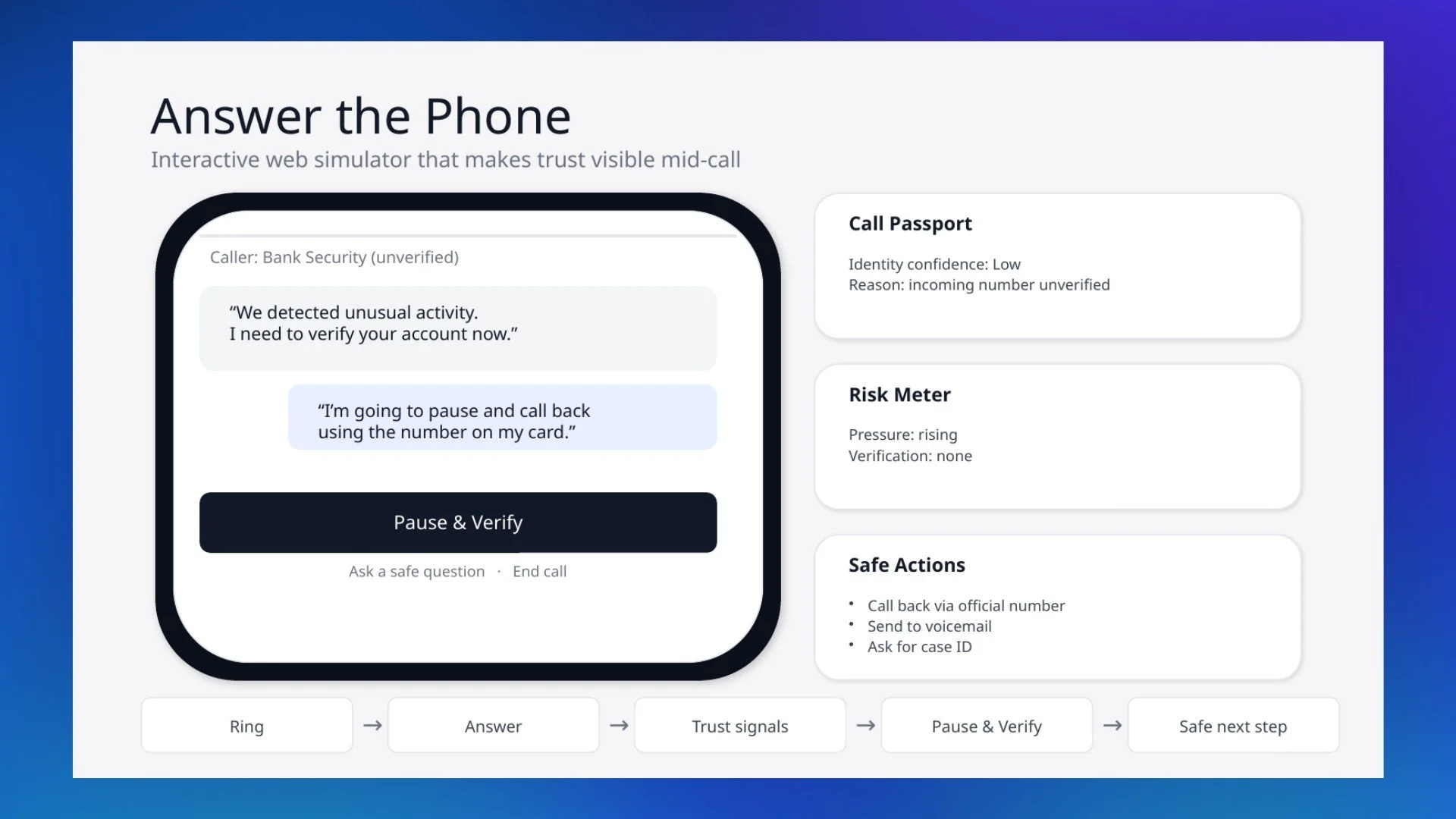
The Call Passport overlay introduces contextual support at the point of decision. Rather than relying on a single warning label, it presents layered trust cues that help the user interpret the call more calmly. This might include familiarity signals, verification prompts, or guidance that slows the pressure of immediate response.
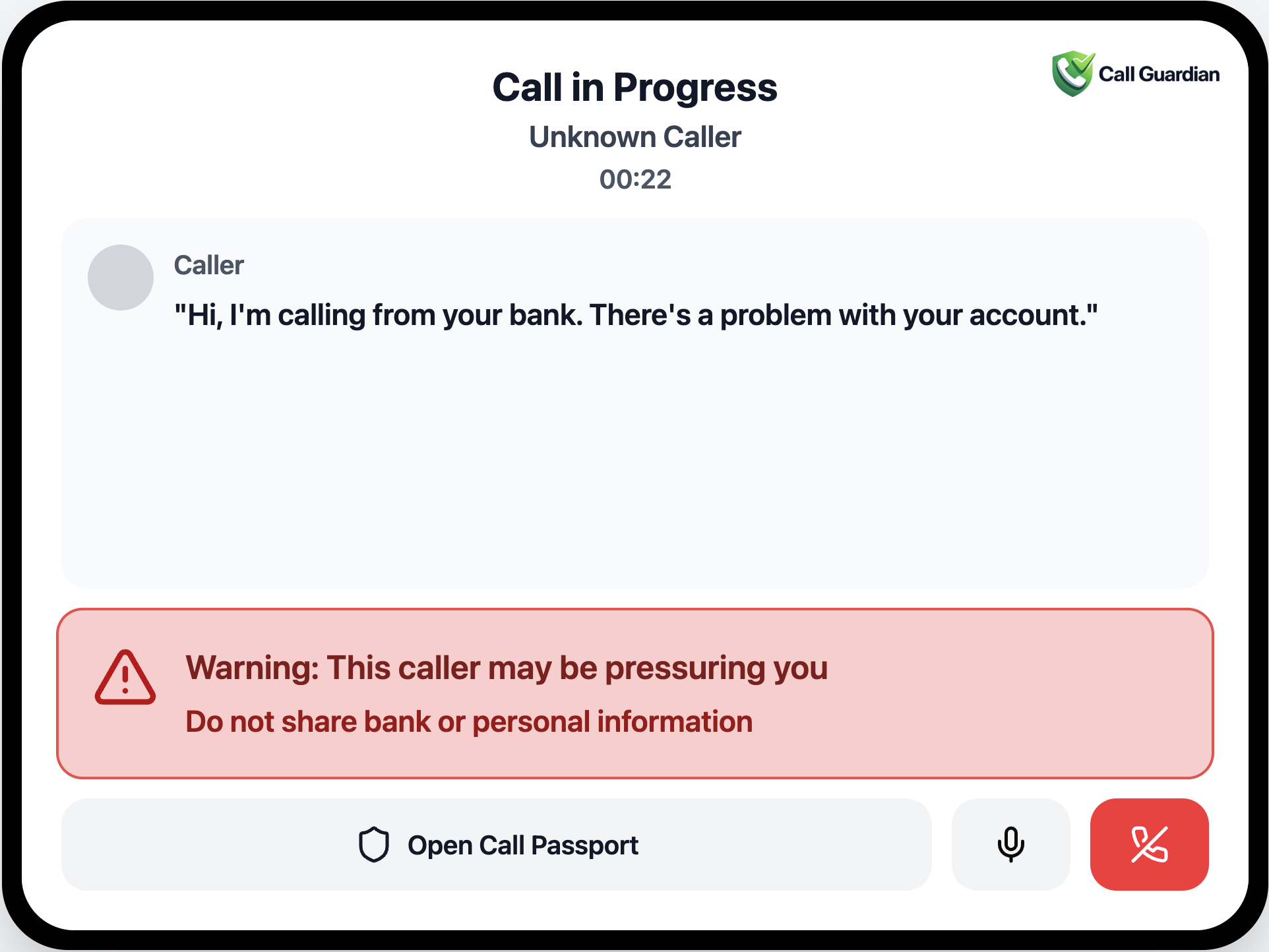
Call Passport overlay adds identity and trust cues before the user answers.
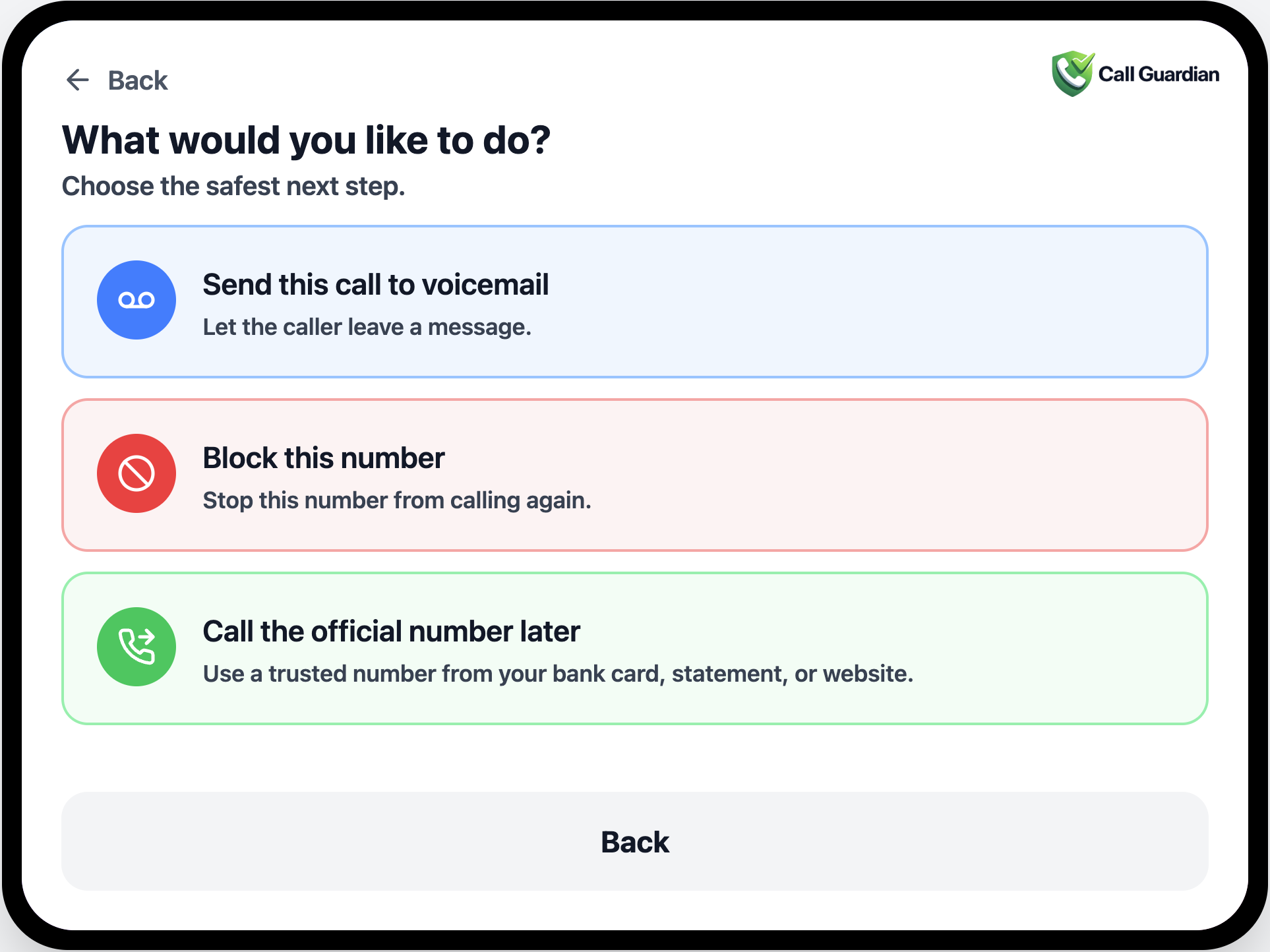
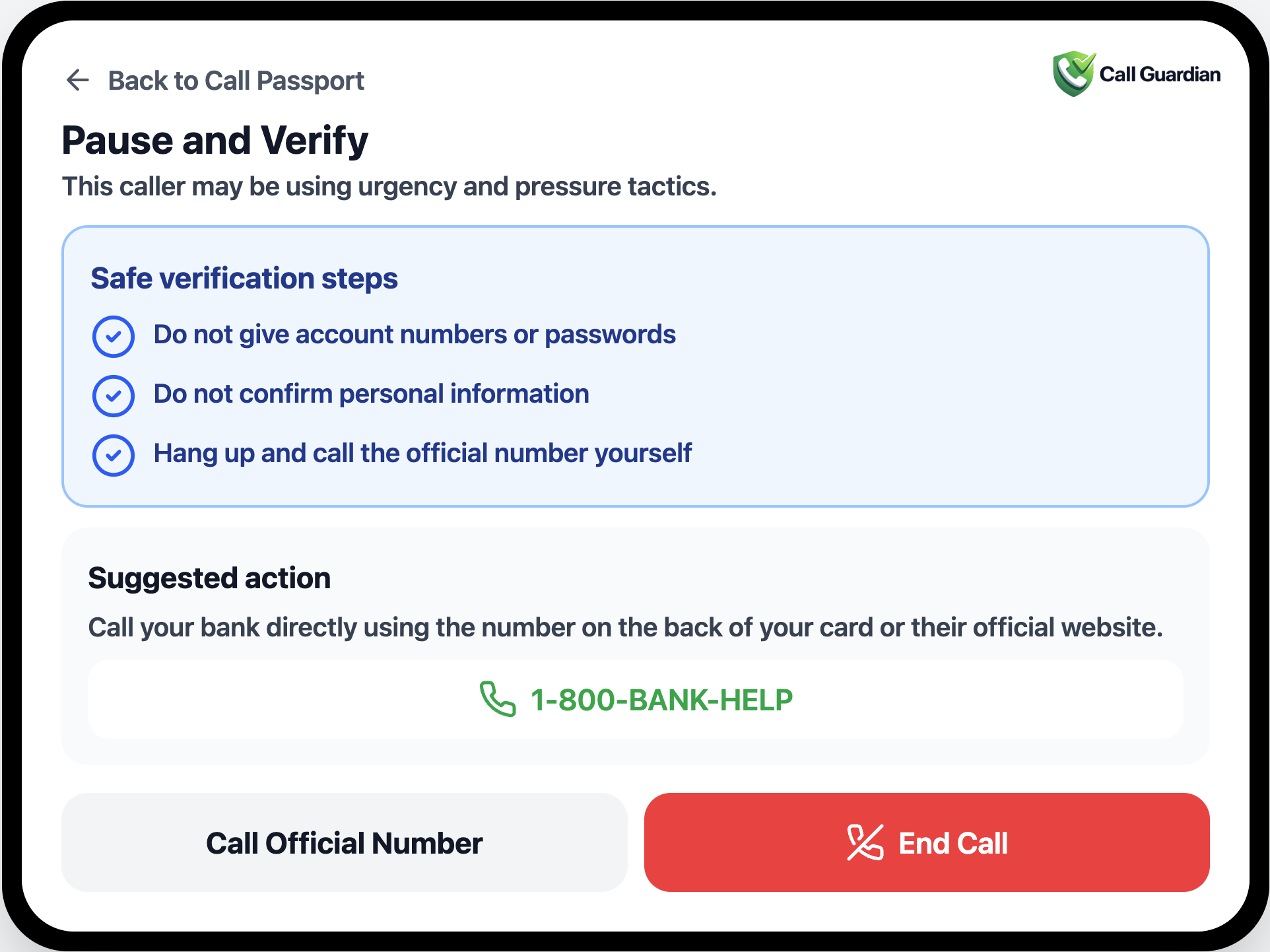
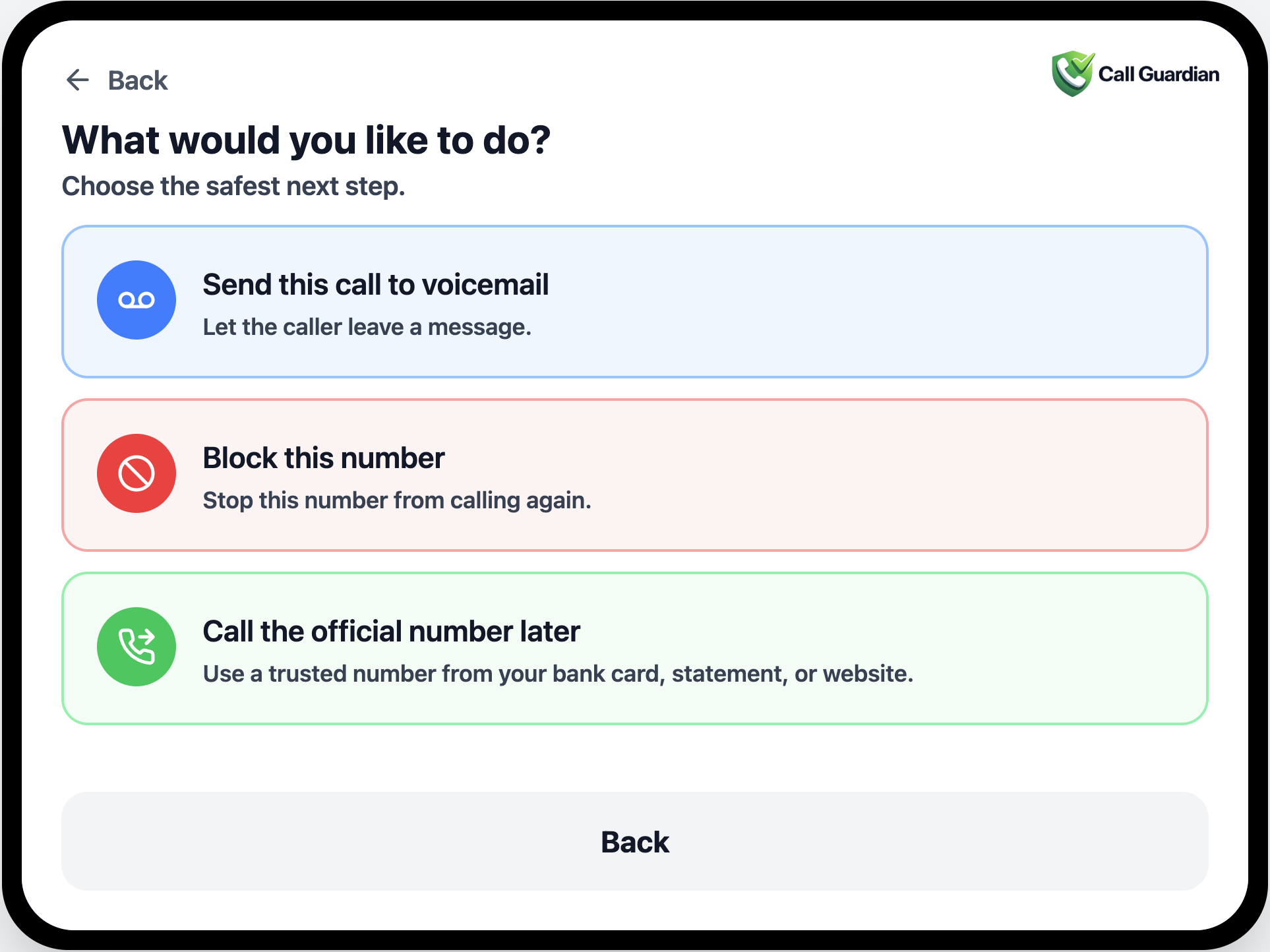
Safe Actions screen provides lower-pressure alternatives to answering immediately.
Trust Circle
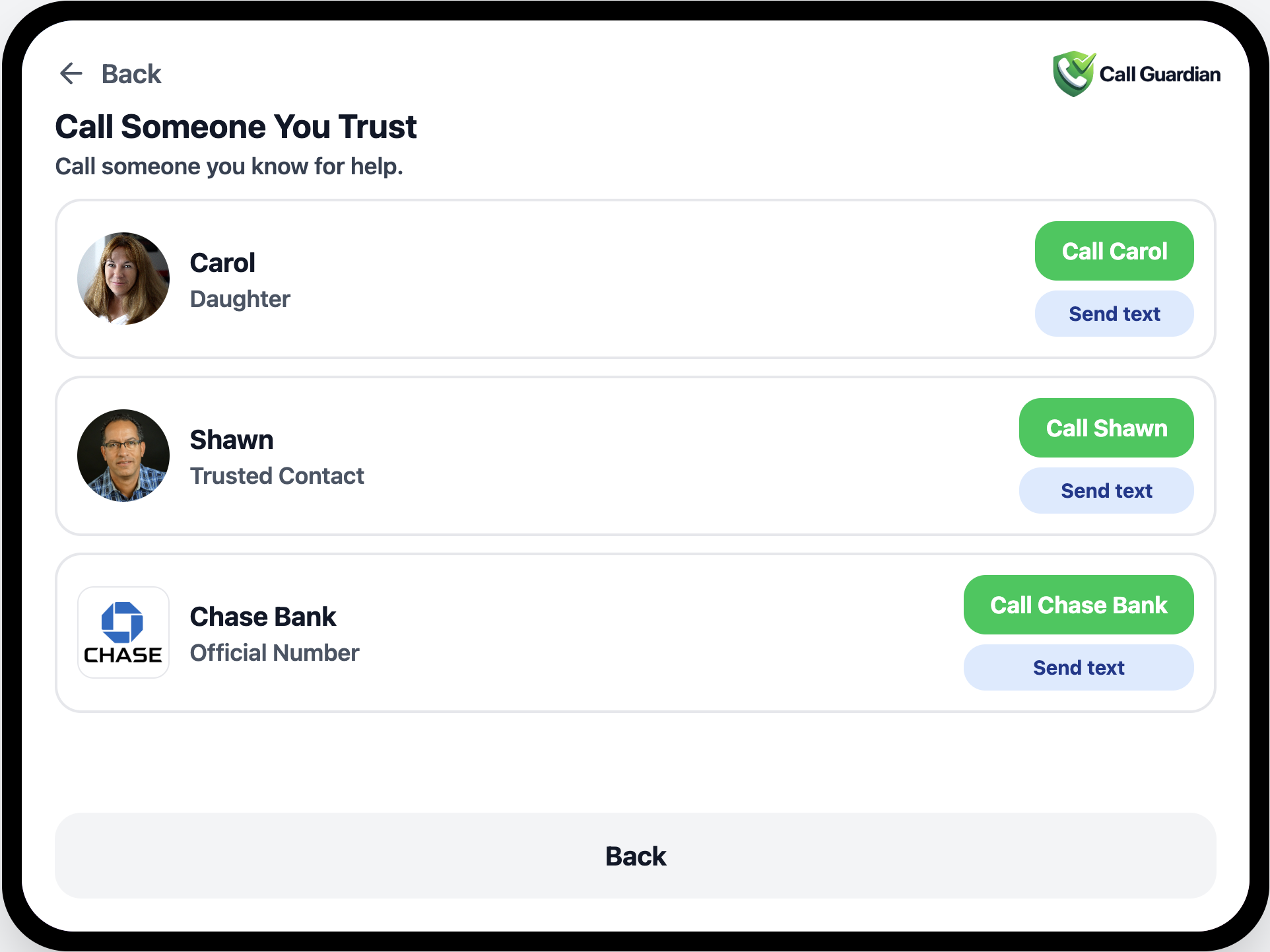
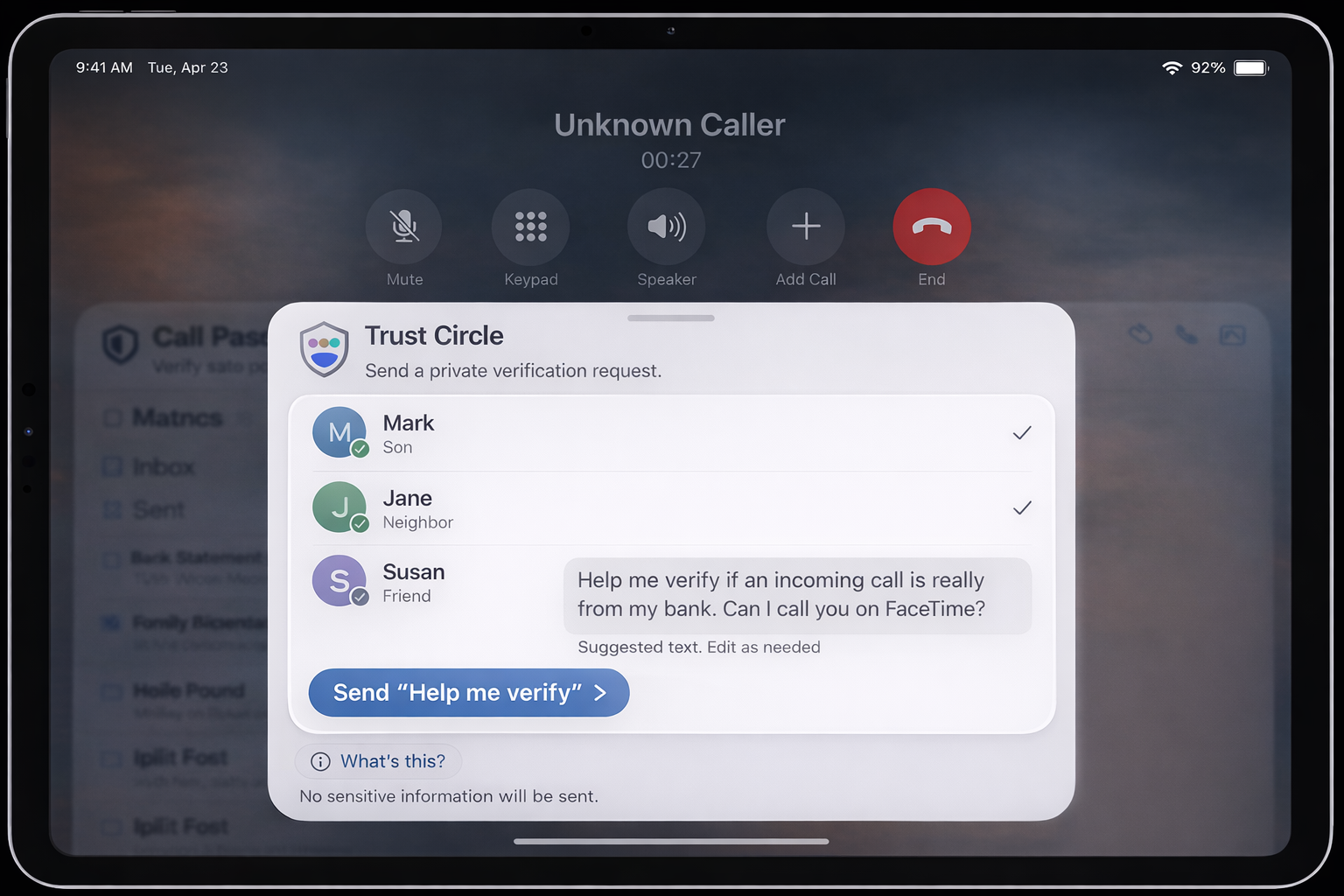
The Trust Circle feature imagines optional support from people the user already trusts, such as family members or caregivers. This support is not imposed automatically. Instead, it is presented as an available resource that the user can choose to involve when needed.
Safe Actions
Instead of forcing a binary answer-or-decline choice, the prototype offers safer alternatives. These actions might include sending the caller to voicemail, requesting a callback reason, verifying the source, or marking the call for later review. This creates a wider range of responses that feel more realistic and supportive.
Trust Circle concept offers optional help from trusted contacts without removing autonomy.
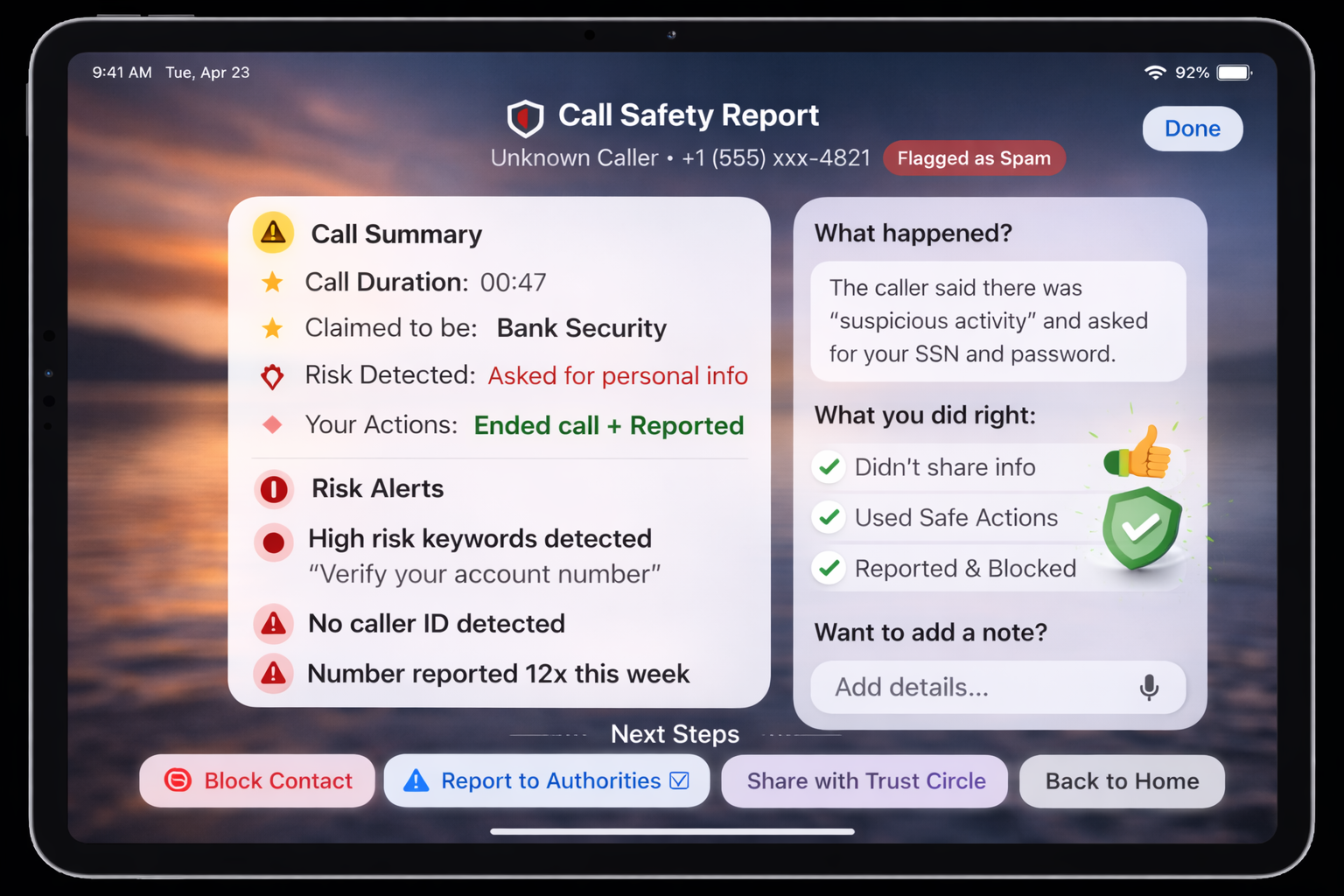
Feedback Loop
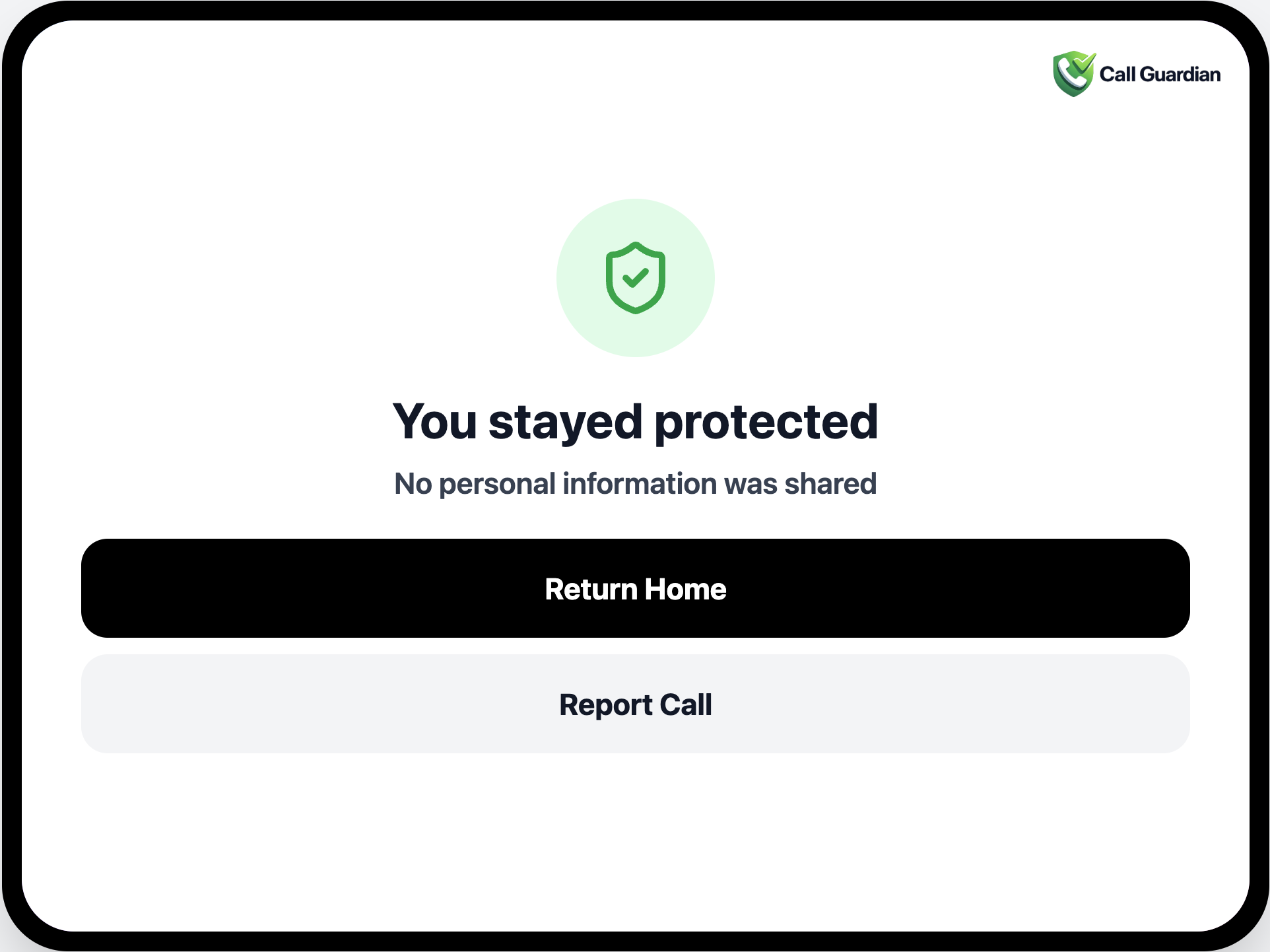
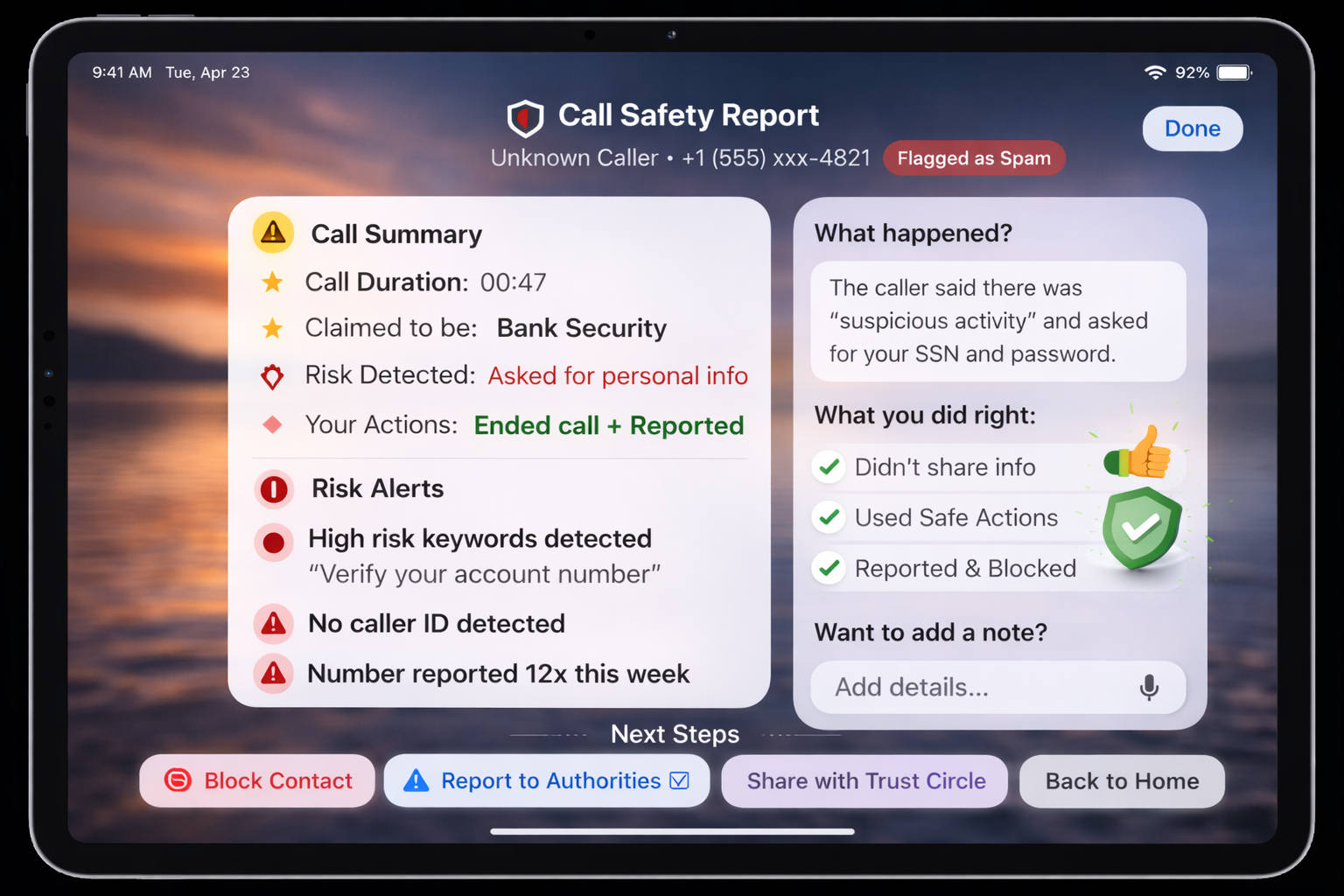
After the interaction, the system can help the user label the outcome and reflect on what happened. This creates the possibility for learning over time and helps turn one uncertain interaction into part of a larger support system.
Feedback loop helps the system and the user build better awareness over time.
Core Design Features
The concept is built around five key features that work together as a system.
Call Passport
A contextual layer that appears during an incoming call to provide trust cues, identity information, and gentle guidance.
Dignity Mode
A tone and interaction style that avoids alarmist language and supports safety without making the user feel blamed, naive, or incapable.
Safe Actions
A set of response options that go beyond answering or hanging up, allowing the user to slow down and choose a safer path.
Trust Circle
An optional support layer that connects users with trusted contacts when verification or reassurance is needed.
Feedback Loop
A post-call reflection feature that helps users record outcomes, strengthen future guidance, and build confidence over time.
Process
This project developed through research, stakeholder-centered inquiry, concept development, and iterative prototyping. The final result reflects both the original design question and the insights that emerged through testing and reflection.
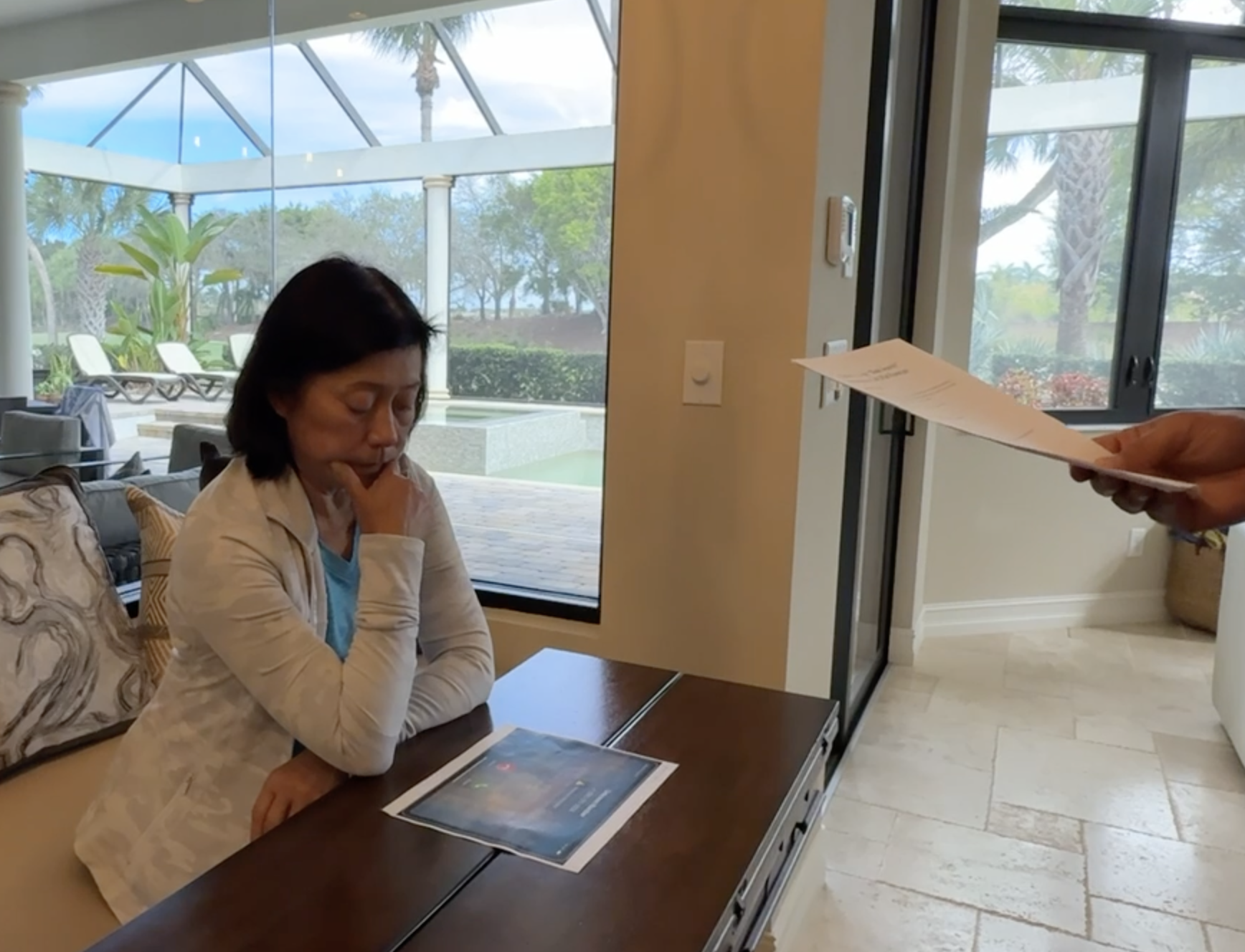
Stakeholder Activity
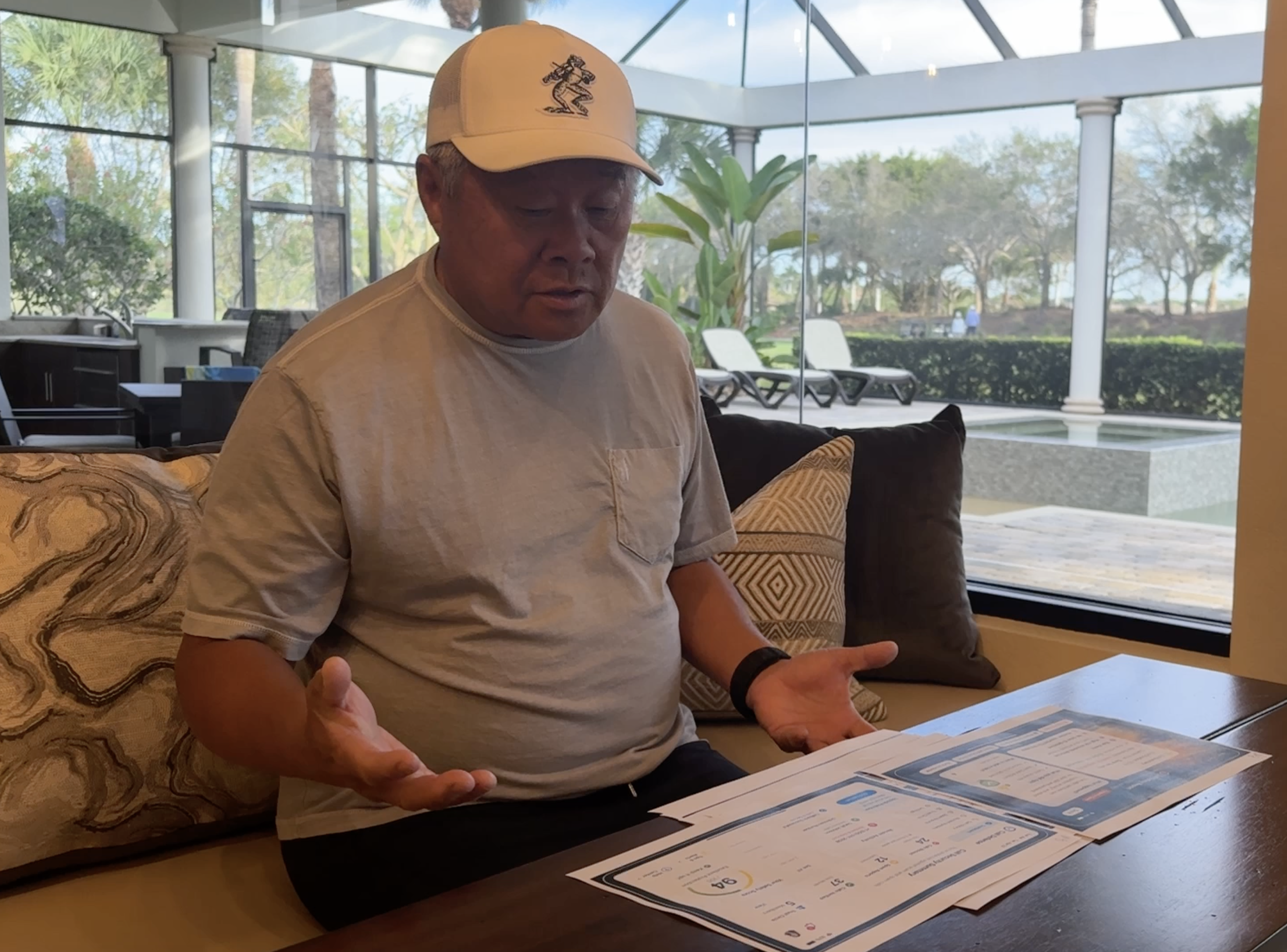
I conducted a user-centered activity to better understand how people respond to unknown calls, what signals they rely on, and what kinds of support feel helpful or intrusive. This stage was important because it grounded the project in lived experience rather than assumption, allowing the design to respond to real behaviors, not idealized ones.
The activity combined semi-structured interviews with scenario-based walkthroughs of a prototype. Participants were asked to reflect on recent experiences with unknown calls and then respond in real time to simulated call situations. This approach made it possible to observe not just what people say they do, but how they actually interpret cues, hesitate, and make decisions in the moment.
Through this process, several patterns emerged. Participants often relied on fragmented or indirect signals—such as area codes, timing of the call, voicemail presence, or gut instinct—rather than any single reliable indicator of legitimacy. Many described feeling a tension between curiosity and caution, especially when a call might be important. This ambiguity frequently led to stress, second-guessing, or delayed follow-up.
The activity also surfaced how emotional and social dynamics shape decision-making. Urgency, authority cues, and familiarity cues (such as a local number) were shown to strongly influence whether a call was answered. At the same time, participants expressed a reluctance to appear rude or unresponsive, even when they were suspicious. This highlights that answering a call is not purely a rational decision—it is also shaped by social norms and expectations.
In terms of support, there was a clear distinction between what felt empowering versus intrusive. Participants responded positively to tools that provided additional context or allowed them to stay in control of the interaction. In contrast, overly aggressive warnings or prescriptive messaging were often perceived as stressful, patronizing, or easy to ignore over time. This reinforced the importance of designing systems that guide rather than dictate.
Overall, this stage revealed that the challenge is not simply identifying scams, but supporting people through a moment of uncertainty. It clarified that effective design must account for incomplete information, emotional pressure, and the need for autonomy—insights that directly informed the development of a calmer, layered interface built around trust, clarity, and user agency.
Concept Development
Using insights from research and stakeholder engagement, I began developing the structure of a more supportive call interface—one that reframes the incoming call moment as something that can be guided, rather than reacted to. Early concept exploration focused on four key dimensions: providing meaningful caller context, introducing lightweight verification signals, offering optional support pathways, and reducing the emotional pressure tied to immediate decision-making.
In early sketches, I tested ways of surfacing caller information beyond just a name or number—such as known relationships, prior interactions, or system-generated context cues. At the same time, I explored verification as a spectrum rather than a binary “safe vs. scam” label, allowing the interface to communicate degrees of confidence instead of definitive judgments. This helped avoid reinforcing fear-based interactions while still supporting informed decision-making.
Another important direction was the idea of optional support. Rather than assuming the user must handle the call alone, I introduced concepts like deferring the call, consulting a trusted contact, or using guided prompts to better understand the caller’s intent. These features were designed to preserve user agency while quietly expanding their sense of support.
Equally critical was addressing the time pressure inherent in incoming calls. Traditional interfaces demand an immediate answer or decline, which can create stress—especially in uncertain situations. In response, I explored interaction patterns that slow down the moment: extending the decision window, breaking information into digestible layers, and allowing users to engage with the call at their own pace.
These explorations ultimately led to the core concept of a layered interface. Instead of presenting a single warning or decision point, the interface unfolds progressively—starting with simple, glanceable cues and offering deeper levels of detail and action as needed. This layered approach supports a wider range of users, from those who want quick reassurance to those who need more context before acting, aligning the system with the broader goal of designing for safety with clarity, agency, and dignity.
Research and Framing
I began by researching fraud, aging, trust, and the emotional dynamics of unknown calls to better understand the broader context in which these interactions occur. This included looking at patterns in phone-based scams, especially those targeting older adults, as well as literature on cognitive load, decision-making under uncertainty, and how trust is formed—or disrupted—through digital interfaces.
This early stage revealed that the problem extends beyond the technical challenge of identifying fraudulent calls. Many existing solutions frame the issue as one of detection: flagging spam, blocking numbers, or warning users after risk has already been inferred. While these approaches are valuable, they often overlook the lived experience of the moment when a call arrives. At that point, users are asked to make a rapid decision with minimal context, often while being interrupted or caught off guard.
For older adults in particular, this moment can be especially complex. Research highlighted how factors such as unfamiliarity with evolving scam tactics, varying levels of digital literacy, and social expectations around politeness or responsiveness can increase vulnerability. Importantly, these are not deficits, but contextual realities that shape how people interpret and act on incoming information.
I also examined how trust operates within communication systems. Caller ID, for example, presents itself as a neutral identifier, but in practice it can be easily manipulated. This creates a disconnect between what the interface implies (a stable, identifiable caller) and what the user can actually rely on. That gap introduces ambiguity, which users must resolve on their own—often under time pressure.
From this perspective, it became clear that the core issue is not simply about detecting scams, but about how communication systems distribute responsibility. Current interfaces tend to place the burden entirely on the user to interpret risk, often without providing meaningful support. This can lead to anxiety, hesitation, or misplaced confidence.
As a result, I reframed the project away from a purely defensive or detection-based model and toward a design question centered on legibility, agency, and dignity. Legibility refers to how clearly the system communicates what is known, what is uncertain, and what actions are available. Agency emphasizes the user’s ability to make informed decisions without being rushed or overridden. Dignity focuses on ensuring that support is offered in a way that is respectful, non-patronizing, and aligned with users’ lived experiences.
This reframing established a foundation for the rest of the project, guiding both the conceptual direction and the design principles behind the prototype.
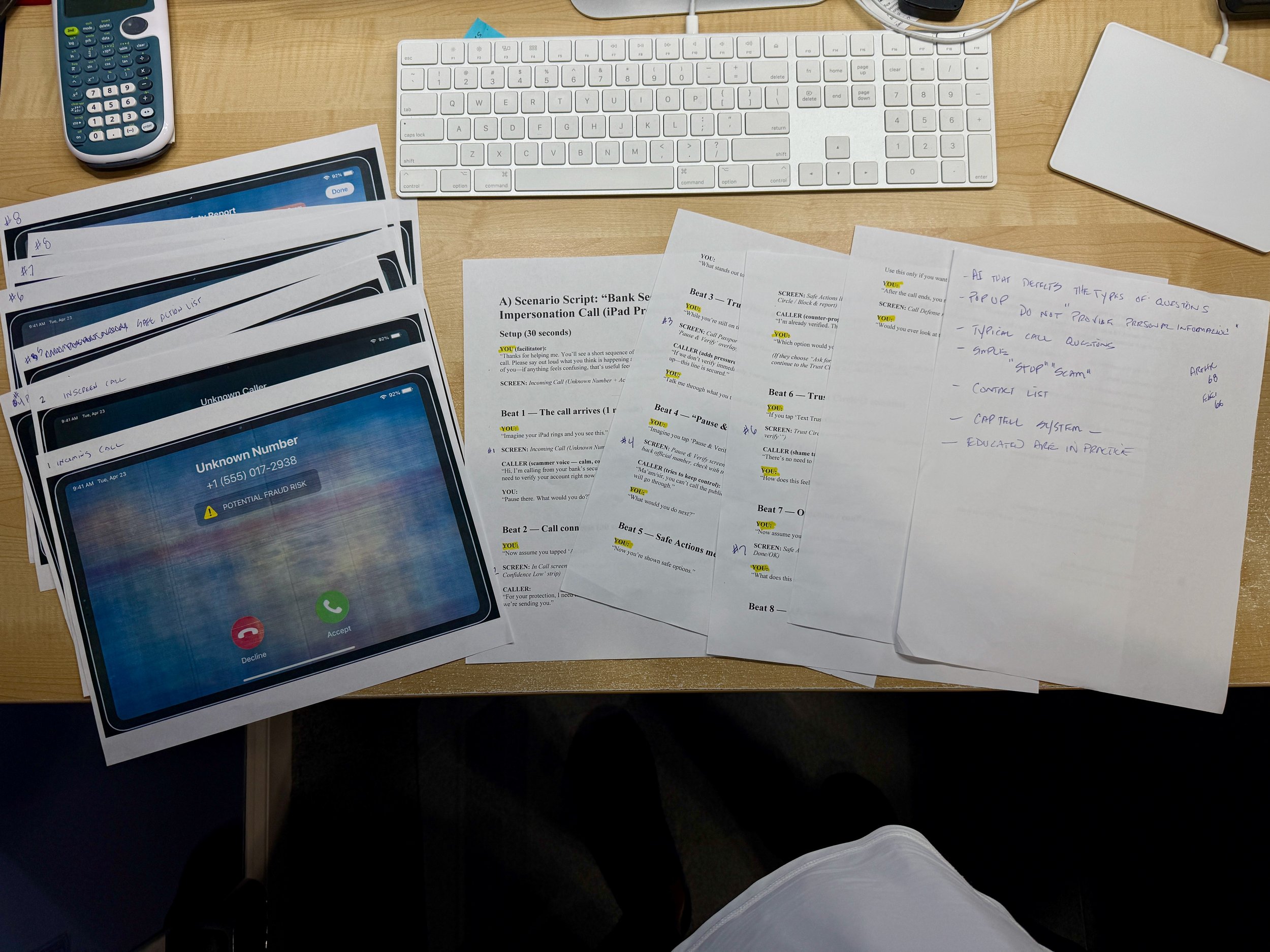
Early iterations
End Prototype
Prototype Iteration
As the prototype developed, I refined both the visual language and the interaction model through multiple rounds of iteration. Using Figma as the primary design platform, I was able to rapidly test layout variations, interaction flows, and information hierarchy. The focus throughout was on creating an interface that feels calm, legible, and respectful—especially in a moment that is typically abrupt and high-pressure.
Visually, this meant moving away from conventional alert patterns that rely on bright reds, alarm icons, or urgent phrasing. Instead, I explored a softer, more composed visual system: neutral color palettes, clear typography, and structured spacing that supports quick comprehension without overwhelming the user. Information was organized into layers, allowing users to engage at a glance or access more detail progressively, depending on their needs.
In parallel, I refined the interaction model to reduce the demand for immediate decision-making. Rather than forcing a binary “answer or decline” action, the interface began to offer a range of safe, intermediate options—such as screening the call, requesting more context, or deferring the interaction. These changes were intended to shift the experience from reactive to supported, giving users more control over how they engage.
Throughout this process, I incorporated iterative feedback from informal testing and ongoing reflection. I also used ChatGPT as a tool to explore and refine language—experimenting with different tones, phrasings, and microcopy strategies. This was particularly important in shaping how the interface communicates risk without creating unnecessary fear or confusion. Subtle shifts in wording—such as replacing directive warnings with suggestive guidance—had a significant impact on how the system felt to users.
Later versions of the prototype moved away from fear-heavy warning language and toward a more nuanced system of trust cues and safe actions. Instead of presenting definitive judgments, the interface communicates levels of confidence, contextual signals, and available choices. This approach supports informed decision-making while preserving user autonomy.
Overall, these refinements brought the prototype into closer alignment with the project’s larger goal: designing for safety with dignity. The interface does not attempt to control the user’s behavior, but rather to clarify the situation, reduce pressure, and provide meaningful support in a moment of uncertainty.
Key Insights from Stakeholder Engagement
The stakeholder activity generated several insights that directly shaped the design.
“People do not only need protection. They need tools that preserve their sense of independence and self-trust.”
— Insight 1Design response:
This insight led me to avoid alarm-heavy messaging and instead develop a calmer interface built around interpretation, guidance, and choice.
“The moment an unknown call appears creates pressure before the caller even speaks.”
— Insight 2Design response:
This shaped the prototype’s focus on pre-answer support, especially through the Call Passport overlay and Safe Actions.
“People often rely on informal trust systems, such as memory, family, or past experience, when deciding whether to engage with a caller.”
— Insight 3Design response:
This directly informed the Trust Circle concept, which makes supportive verification available without taking control away from the user.
Iteration and Design Decisions
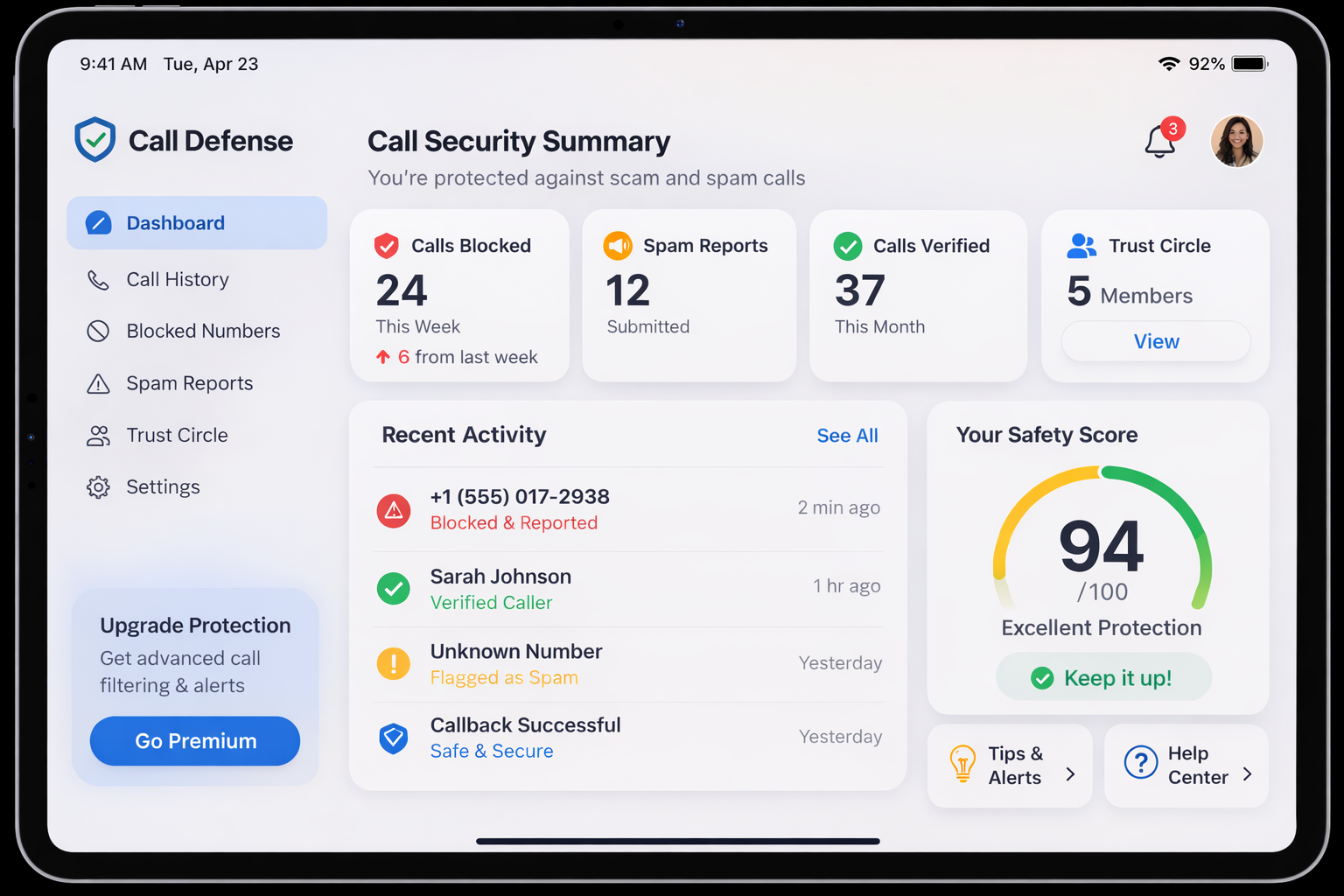
One of the most important changes in the project was the shift from warning-oriented design to dignity-oriented support. Earlier versions of the concept relied more heavily on caution and threat framing. As the project developed, I realized that this approach risked reinforcing fear rather than creating confidence.
In response, I refined the design language to feel calmer, more readable, and more respectful. I also expanded the system beyond a single call screen to include safe action pathways, trusted support, and post-call reflection. These changes made the prototype feel more aligned with the broader vision of supporting users without infantilizing them.
This iteration process helped clarify that the strength of the project is not in claiming perfect scam detection, but in improving the user’s experience of uncertainty.
before
after
Reflection and Next Steps
This project helped me think more critically about the phone as a social interface rather than just a technical device. It also pushed me to consider how design can address vulnerability without reducing people to risk categories. Through this process, I became more interested in how interaction design can support care, trust, and independence in ordinary moments of everyday life.
The final prototype is one possible expression of a larger vision. If I continued developing this project, the next steps would include testing the concept with more users, building a higher-fidelity interactive version, and exploring accessibility considerations such as readability, cognitive load, and platform-specific implementation. I would also want to further examine how trusted support systems can be integrated in ways that remain empowering rather than intrusive.
More broadly, this project suggests that safer communication systems do not have to rely only on fear, surveillance, or rigid warnings. They can also be designed around dignity, interpretation, and meaningful support.
References and Credits
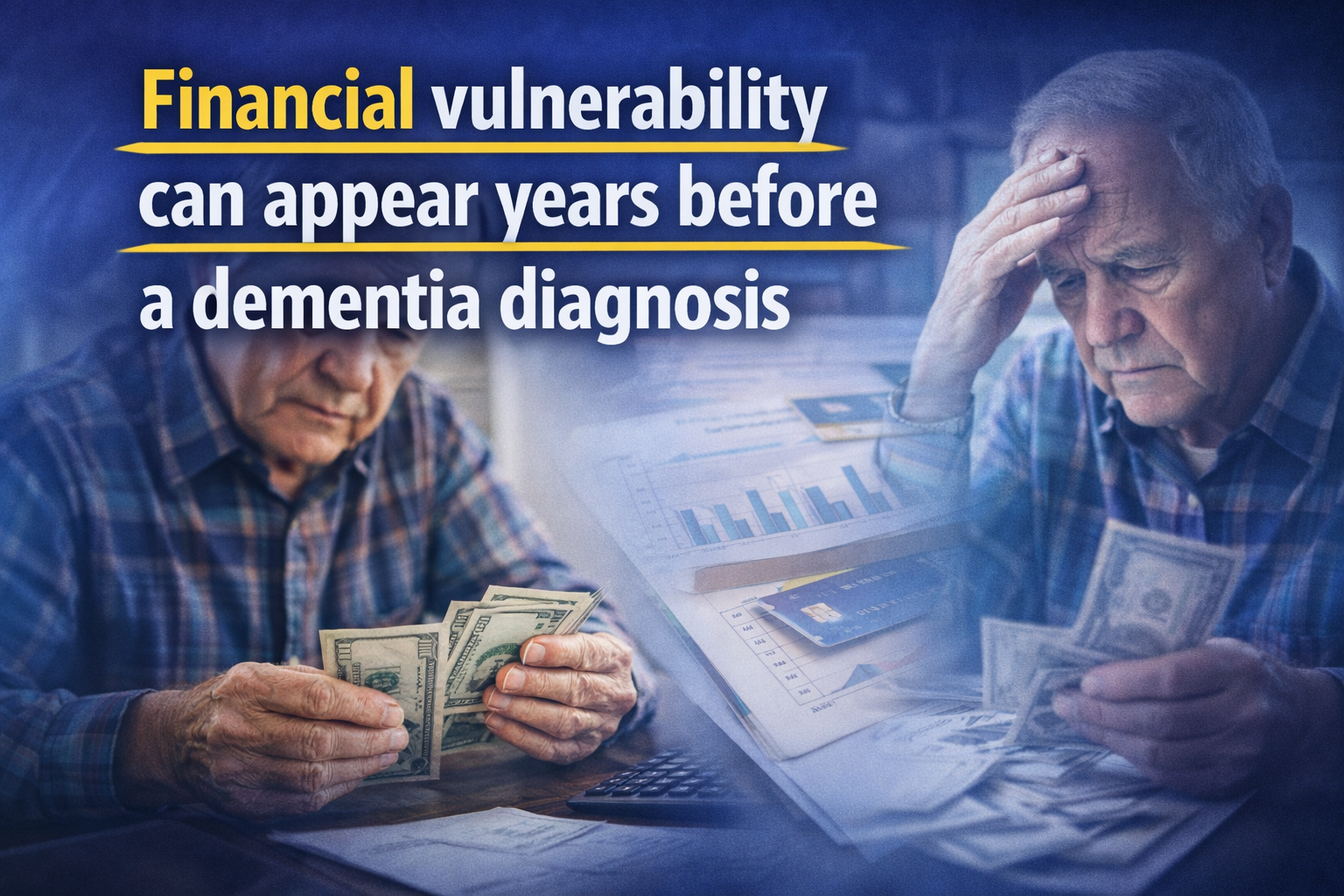
This project draws on research related to scam awareness, aging, trust, financial vulnerability, and communication design, as well as artistic and speculative precedents that frame the phone as a cultural and emotional interface.
Research sources:
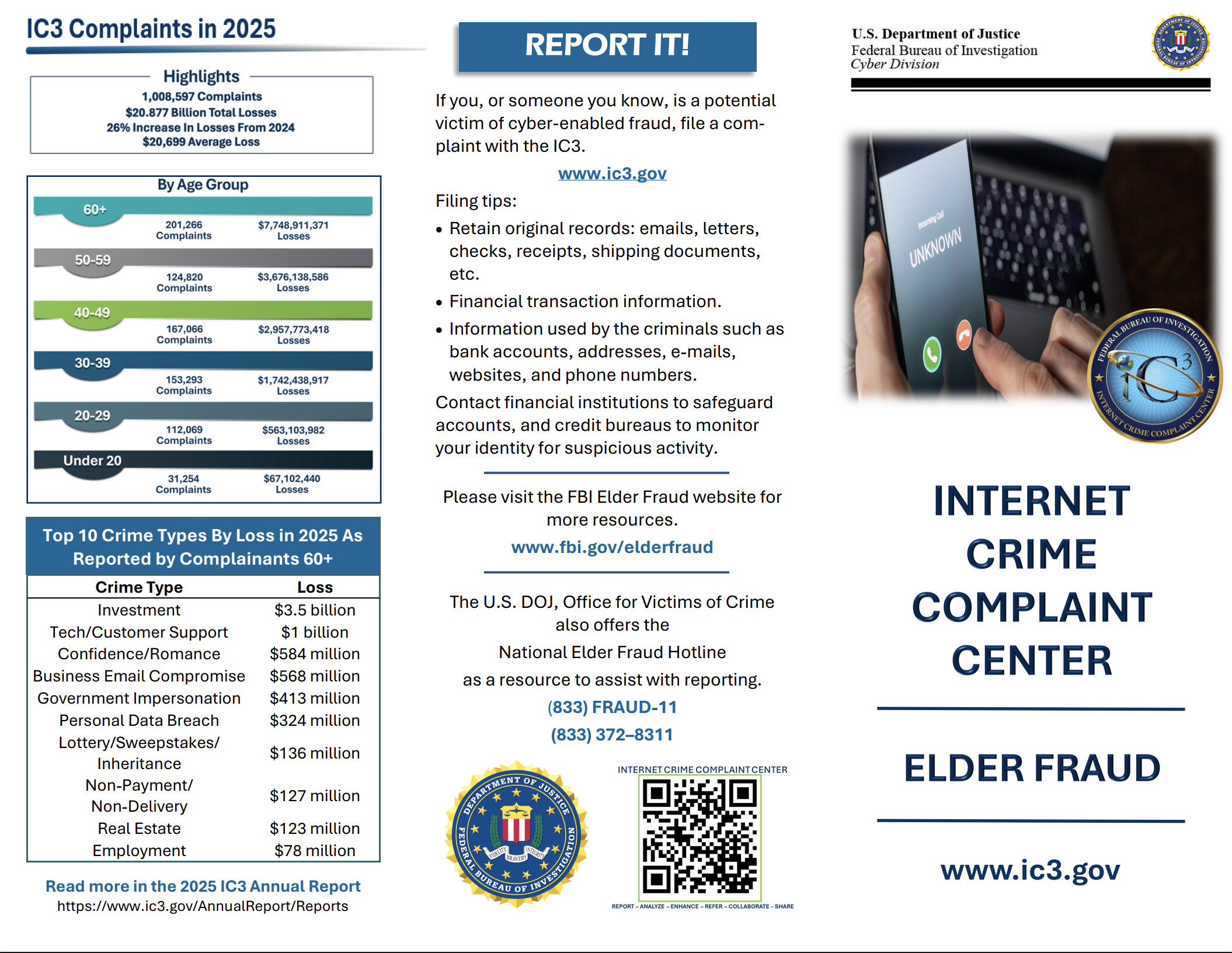
Federal Bureau of Investigation, Internet Crime Complaint Center. (2024). 2024 IC3 annual report [Annual report]. https://www.ic3.gov/AnnualReport/Reports/2024_IC3Report.pdf
Federal Bureau of Investigation, Internet Crime Complaint Center. (n.d.). Elder fraud [Brochure]. https://www.ic3.gov/Outreach/Brochures/elder_fraud_tri-fold.pdf
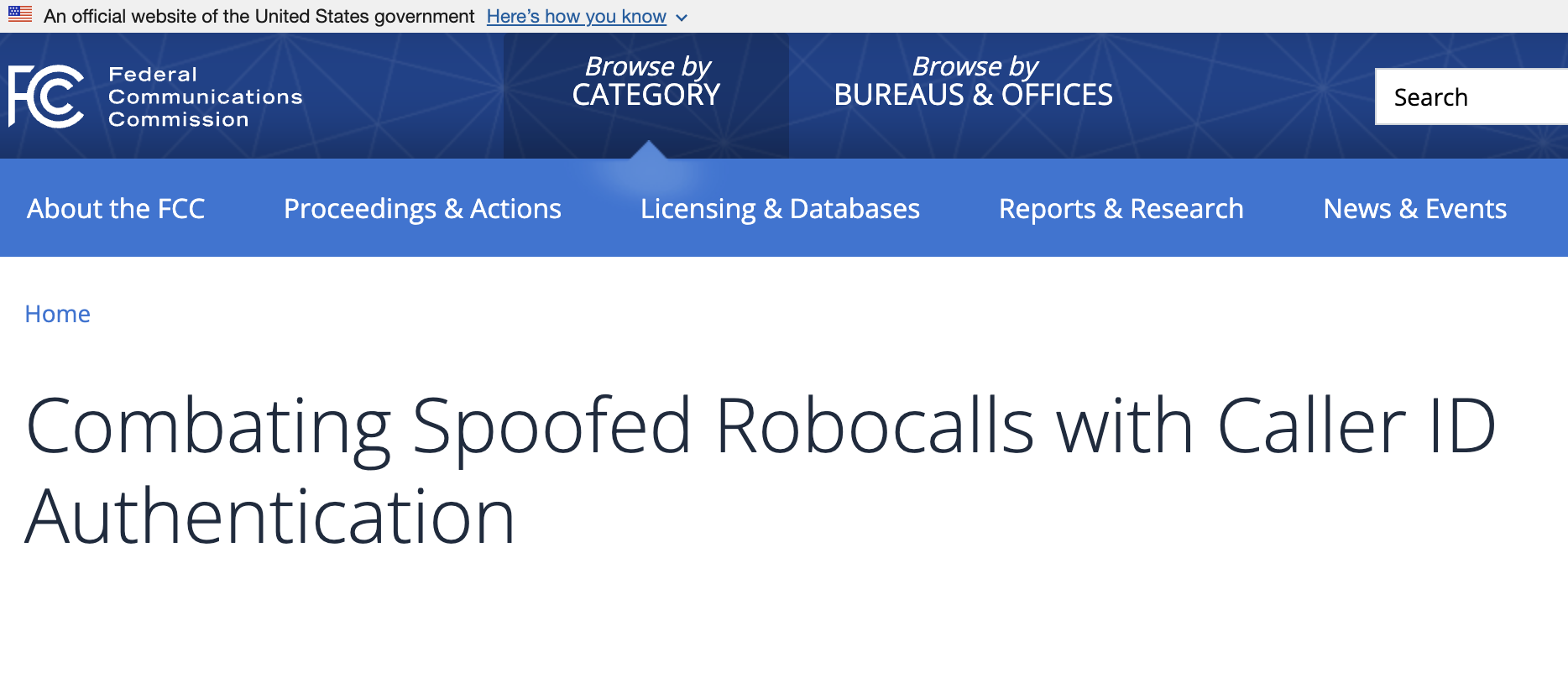
Federal Communications Commission. (n.d.). Call authentication. Retrieved February 19, 2026, from https://www.fcc.gov/call-authentication
Federal Communications Commission. (2021, June 30). STIR/SHAKEN broadly implemented starting today: Caller ID authentication standard is now used by the largest voice service providers, helping protect consumers against spoofed robocalls [Press release]. https://docs.fcc.gov/public/attachments/DOC-373714A1.pdf
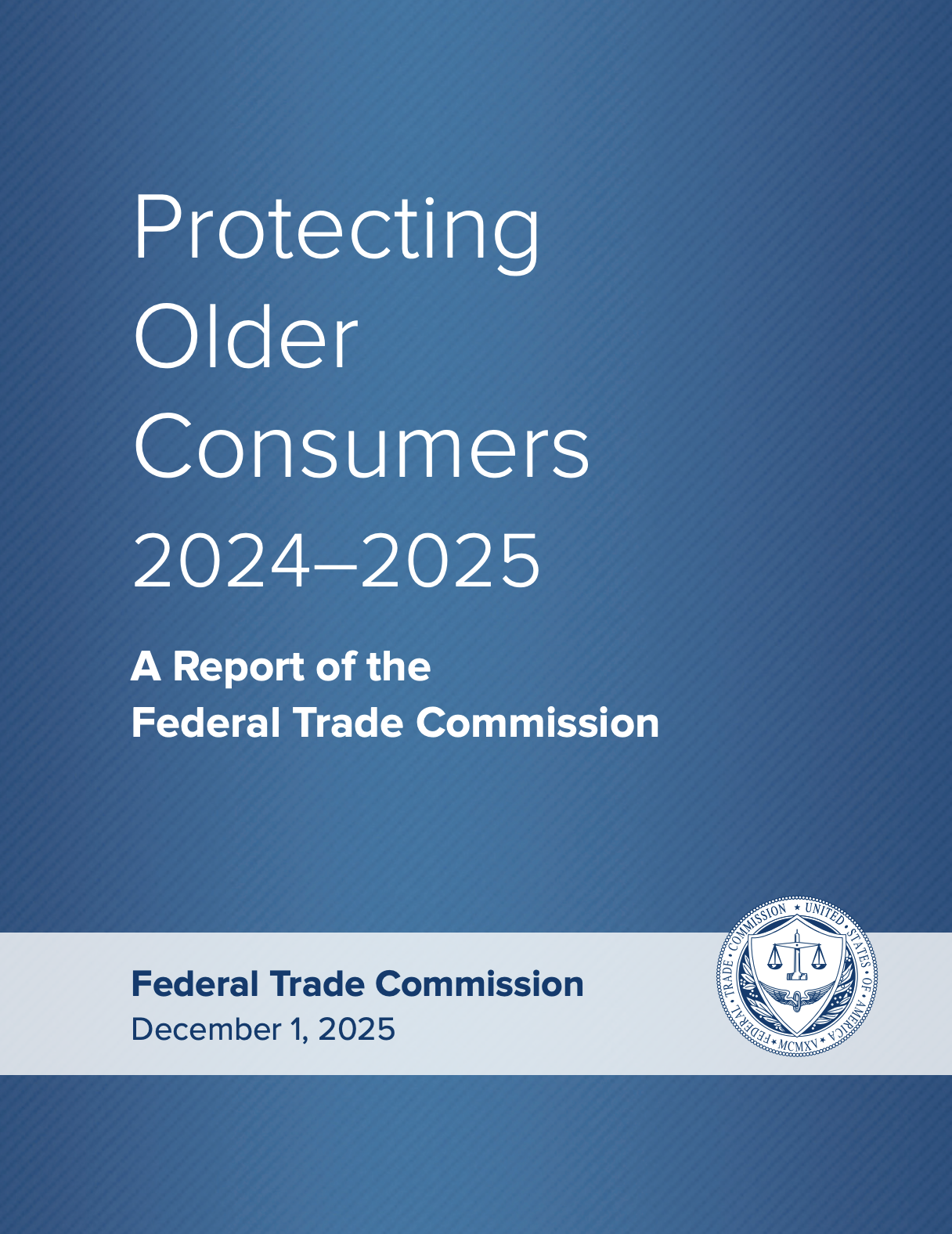
Federal Trade Commission. (2025, December 1). Protecting older consumers 2024–2025: A report of the Federal Trade Commission. https://www.ftc.gov/system/files/ftc_gov/pdf/P144400-OlderAdultsReportDec2025.pdf
Han, S. D., Boyle, P. A., James, B. D., Yu, L., & Bennett, D. A. (2015). Mild cognitive impairment and susceptibility to scams in old age. Journal of Alzheimer’s Disease, 49(3), 845–851. https://doi.org/10.3233/JAD-150442
National Institute on Aging. (2021, January 14). Dementia may cause problems with money management years before diagnosis. https://www.nia.nih.gov/news/dementia-may-cause-problems-money-management-years-before-diagnosis
National Institute on Aging. (2023, October 3). Managing money problems for people with dementia. https://www.nia.nih.gov/health/legal-and-financial-planning/managing-money-problems-people-dementia
Nicholas, L. H., Langa, K. M., Bynum, J. P. W., & Hsu, J. W. (2021). Financial presentation of Alzheimer's disease and related dementias. JAMA Internal Medicine, 181(2), 220–227. https://doi.org/10.1001/jamainternmed.2020.6432
Ueno, D., Daiku, Y., Eguchi, Y., Iwata, M., Amano, S., Ayani, N., Nakamura, K., Kato, Y., Matsuoka, T., & Narumoto, J. (2021). Mild cognitive decline is a risk factor for scam vulnerability in older adults. Frontiers in Psychiatry, 12, 685451. https://doi.org/10.3389/fpsyt.2021.685451
Design references:
This project draws on a range of existing systems and design approaches that explore trust, safety, and communication under uncertainty. Rather than replicating any one model, these references informed how the prototype frames information, supports decision-making, and respects user autonomy.
One key reference is call screening and spam detection features found in platforms like Google’s Pixel Call Screen and Apple’s Silence Unknown Callers. These systems demonstrate how automation can intervene in unwanted communication, but they often prioritize blocking or filtering over helping users understand why a call may be risky. This project builds on those ideas by shifting from passive filtering to active sensemaking.
I also looked at verification and trust signaling in other domains, such as two-factor authentication, verified badges on platforms like Instagram, and identity confirmation in financial apps. These systems show how trust can be communicated through layered signals rather than absolute claims. This influenced the development of a gradient-based trust model within the interface.
Another important reference comes from accessibility and inclusive design practices. Research and guidelines from organizations like Microsoft Inclusive Design emphasize clarity, flexibility, and respect for a wide range of user abilities and contexts. This directly informed decisions around legibility, pacing, and reducing cognitive load—particularly for older adults navigating unfamiliar or stressful situations.
Finally, I drew inspiration from calm technology principles, which advocate for systems that inform without overwhelming and support users without demanding constant attention. This perspective helped shape the overall tone of the interface, moving away from urgent, fear-based alerts toward a more composed and supportive interaction model.
Together, these references guided the project toward a design approach that prioritizes legibility, agency, and dignity—positioning the interface not just as a filter, but as a tool for understanding and navigating uncertainty.
Prototype images, visuals, and music:
Shawn O Smith created all images and visuals.
Music by Soundstripe Royalty Free Music
Acknowledgments:
Thank you to my lovely wife, family, and friends that help a participated in helping me develop this prototype.